
A Complete Guide for Aesthetic Professionals
You’ve invested in top-of-the-line equipment, trained your staff, and created a beautiful space where clients feel relaxed and valued. But here’s the truth that keeps many med spa owners up at night: If potential clients can’t find you online, none of that matters.
This is where SEO (Search Engine Optimization) comes in. If you’re still wondering whether SEO is worth the investment for your med spa, this guide will change your mind. We’ll walk you through exactly how SEO helps med spas attract more clients, increase online bookings, and build a thriving practice without relying on expensive ads.
Why SEO is Critical for Med Spas Right Now
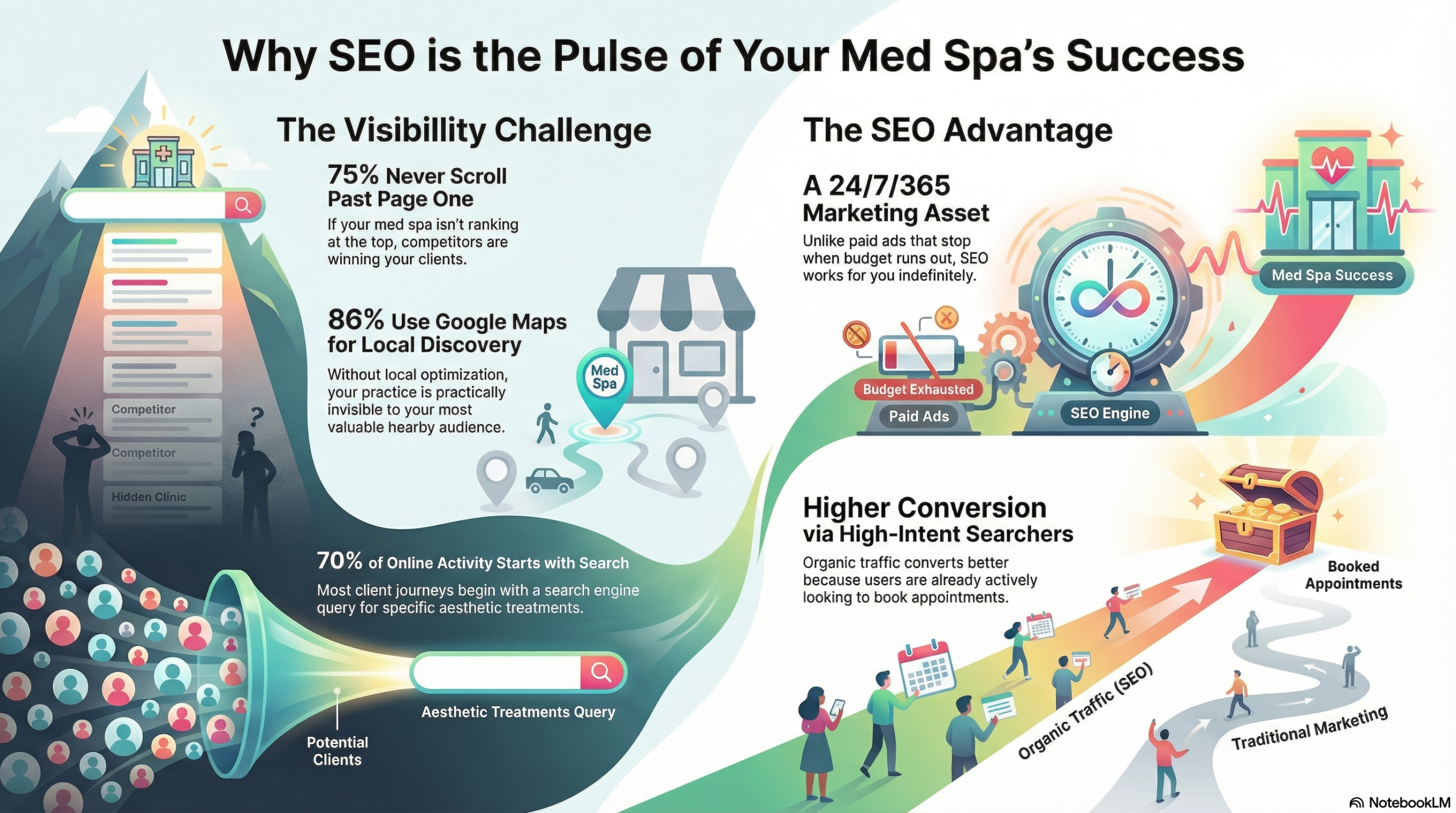
Let’s start with some eye-opening numbers: About 70% of all online activity begins with a search engine. When someone searches for “Botox near me” or “laser hair removal in [Your City],” they’re actively looking for your services. The question is: Are they finding you?
Here’s the challenge: 75% of search engine users never scroll past the first page. If your med spa isn’t ranking in those top positions, you’re losing potential clients to competitors who are. These aren’t random visitors scrolling through ads—these are high-intent searchers actively ready to book an appointment.
Compare this to traditional advertising. When you run a Facebook ad or Google Ad, you’re paying for every click. With SEO, you’re building an asset that works for you 24/7, 365 days a year. Organic traffic from SEO typically converts at higher rates because users are already searching for exactly what you offer.
And here’s the kicker: 86% of consumers use Google Maps to find local businesses. If your med spa isn’t optimized for local search, you’re practically invisible to your most valuable audience.
The 5 Pillars of Med Spa SEO That Actually Work
Pillar 1: Strategic Keyword Foundation
The biggest mistake med spas make is trying to rank for everything. You don’t need to rank for generic terms like “med spa” nationally. Instead, focus on high-intent, treatment-specific keywords that real patients are searching for in your area.
Here’s the breakdown:
Treatment + Location Keywords: These are your gold mine. Searches like “Botox in [Your City],” “laser hair removal in [Your Location],” or “microneedling near me” show that someone is ready to book. These keywords typically have lower competition than national terms and attract qualified leads.
Problem-Solution Keywords: Potential clients often search for solutions before they know the treatment name. Keywords like “how to get rid of acne scars,” “best way to remove facial hair,” or “non-invasive skin tightening” capture people in research mode—but still highly valuable.
Commercial Intent Keywords: Phrases like “best med spa near me” or “top-rated laser treatment provider” show someone is comparing options and ready to choose.
Pro Tip: Use Google’s “People Also Ask” and “Searches Related To” sections when you search for your main treatments. These reveal exactly what potential patients are actually searching for. Then use keyword research tools like Google Keyword Planner, SEMRush, or Ahrefs to understand search volume and competition.
Example: “Botox near me” gets approximately 110,000 searches per month, while “medical spa near me” only gets about 60,000. But drilling down to suburb-specific queries like “Botox in [specific neighborhood]” might only have 100 searches per month—yet the keyword difficulty drops significantly, making it easier to rank for with less competition.
Pillar 2: Dominate Google My Business (Your Local Powerhouse)
Your Google My Business (GMB) profile is perhaps the single most important local marketing tool you have—and it’s completely free.
When someone searches for “med spa near me” or “Botox in [Your City],” Google shows them three things: a map with your location, your business information, and reviews. If your med spa isn’t there, you lose the sale before they even visit your website.
Here’s why GMB matters so much:
- Businesses with complete GBP profiles get 7x more clicks than those without
- 72% of consumers who search locally visit businesses within a five-mile radius
- Photos on your GMB profile get 35% more clicks to your website
- Your profile can be the direct pipeline to bookings without a website visit
How to Set Up and Optimize Your GMB Profile:
- Claim Your Business: Visit google.com/business, sign in with your spa’s Google account, and follow the verification process. This is crucial—unverified profiles have limited visibility.
- Choose the Right Categories: Select your primary category (like “Medical Spa” or “Aesthetics Spa”) and up to 10 additional categories that accurately describe your services. Be specific—this helps Google match you to the right searches.
- Add Keyword-Rich Service Descriptions: Instead of just listing “cosmetic injections,” be specific: “Botox injections in [City],” “Dermal fillers for lip enhancement,” “Microneedling for acne scars.” This is where you naturally incorporate keywords that potential clients are actually searching for.
- Upload High-Quality Photos: Invest in professional photos of your facility, treatment rooms, and results. The before-and-after galleries are particularly powerful for building trust. More photos = better visibility. Aim for at least 20-30 high-quality images.
- Encourage and Manage Reviews: Ask satisfied clients to leave reviews. Google explicitly states that reviews influence rankings, especially for local searches. Respond professionally to all reviews—positive feedback builds trust, and thoughtful responses to negative reviews show you care about resolving issues.
- Keep Your Profile Active: Regularly post updates about new treatments, special offers, or seasonal promotions. Fresh content signals to Google that your business is active and engaged.
- Include Location Information and Pricing: Make your NAP information (Name, Address, Phone Number) clear and consistent across all platforms, including your website. If you offer services, include price ranges when possible.
Pillar 3: Build a Conversion-Focused Website Architecture
Your website isn’t just a brochure—it’s your lead-generating machine. Google rewards websites with strong structure, fast loading times, and mobile-friendly design.
Essential Website Structure:
Service Landing Pages: Create dedicated pages for each major treatment you offer. Instead of a generic “Services” page, have individual pages for “Botox,” “Laser Hair Removal,” “Chemical Peels,” and so on. Each page should be optimized for that specific treatment + your location combination.
For example, a laser hair removal page should include:
- Location-specific headline: “Laser Hair Removal in [Your City] – Smooth Skin Guaranteed”
- High-quality before-and-after photos
- Clear explanation of the procedure and benefits
- Pricing and package information
- Real patient testimonials
- A prominent CTA button: “Book Your Appointment”
- Google Map embed showing your location
Location Pages (if applicable): If you serve multiple areas or neighborhoods, create dedicated pages for each location. This helps you capture searches like “med spa in [Specific Neighborhood].”
Blog Section: Your blog is where you answer the questions potential clients are asking. This content builds trust, establishes expertise, and gives Google fresh, relevant content to index.
Technical SEO Essentials:
- Mobile Responsiveness: More than 60% of searches now happen on mobile devices. If your site isn’t mobile-friendly, you’re losing traffic and rankings.
- Page Speed: Google prioritizes fast-loading pages. Compress images, use a CDN, and minimize code to ensure your site loads in under 3 seconds.
- Clean Site Architecture: Organize your site logically so both users and search engines can easily navigate. Use clear internal linking to pass authority to important pages.
- SSL Certificate: Your site must be secure (HTTPS) for SEO and customer trust.
- Schema Markup: Implement structured data so Google understands what your business offers. For medical spas, this includes local business schema, service schema, and review schema.
Pillar 4: Create Content That Educates and Converts
Medical spa patients need education and trust-building before they book. Your content strategy should address every stage of their decision-making journey.
Content Categories That Work:
Educational Content: Blog posts explaining treatments, answering FAQs, and addressing common concerns. Examples:
- “How Long Does Botox Last? Everything You Need to Know”
- “Microneedling vs. Chemical Peels: Which Is Right for Your Skin?”
- “What to Expect from Your First Laser Hair Removal Appointment”
Trust-Building Content: Showcasing results, credentials, and expertise:
- Before-and-after galleries with client testimonials
- Meet-the-team pages with provider credentials
- Case studies highlighting transformations
- Blog posts written by your practitioners
Local Content: Content that resonates with your specific community:
- “The Most Popular Med Spa Treatments in [Your City]”
- “Preparing for Your Wedding: The Perfect Pre-Wedding Med Spa Treatments”
- Guides to addressing common skin concerns in your climate (sun damage in sunny areas, dryness in cold climates, etc.)
Content Optimization Tips:
- Use Your Primary Keyword in the Right Places: Include it in the page title, first paragraph, headers (H1, H2), and throughout the body text naturally. Tools like SurferSEO and Clearscope show you the ideal keyword frequency for ranking content.
- Write for Real People, Not Just Search Engines: Use conversational language that your actual patients would use. Instead of “ablative laser resurfacing,” you might say “laser treatment to smooth out fine lines and scars.”
- Create Comprehensive Content: Longer, more detailed content tends to rank better. Aim for at least 2,000 words for pillar content and 1,500+ for supporting blog posts.
- Link Strategically: Internal links pass authority and help users navigate your site. Link your blog post about acne scars to your microneedling service page. Link your skin rejuvenation blog to your facial treatment pages.
- Update Old Content: Don’t just publish and forget. Regularly review your top-performing content and update it with new information, fresh statistics, and current examples.
Pillar 5: Build Authority Through Backlinks and Local Citations
Google sees backlinks as “votes of confidence” for your website. When reputable websites link to you, it signals authority and trustworthiness.
Ways to Build Backlinks:
- Local Press Coverage: Submit press releases when you launch new treatments or reach milestones. Local news outlets frequently cover new businesses in town.
- Industry Partnerships: Partner with complementary businesses (fitness studios, beauty retailers, wellness centers) and exchange links or co-create content.
- Expert Contributions: Write guest blog posts for health, beauty, or local publications. Include a link to your website in your author bio.
- Directory Listings: Get listed on trusted directories like RealSelf, Yelp, Healthgrades, and industry-specific sites. These boost credibility and provide backlinks.
Build Local Citations: A citation is any mention of your business name, address, and phone number (NAP) online. Citations help Google understand your business and improve local rankings. Ensure your NAP information is consistent everywhere—inconsistencies confuse search engines and hurt rankings.
Monitor Results: Use Google Search Console to see which keywords are driving impressions and clicks. Identify opportunities to create more content around high-performing terms or improve underperforming pages.
Common Med Spa SEO Mistakes to Avoid
Before we move to specific tactics, let’s talk about what NOT to do:
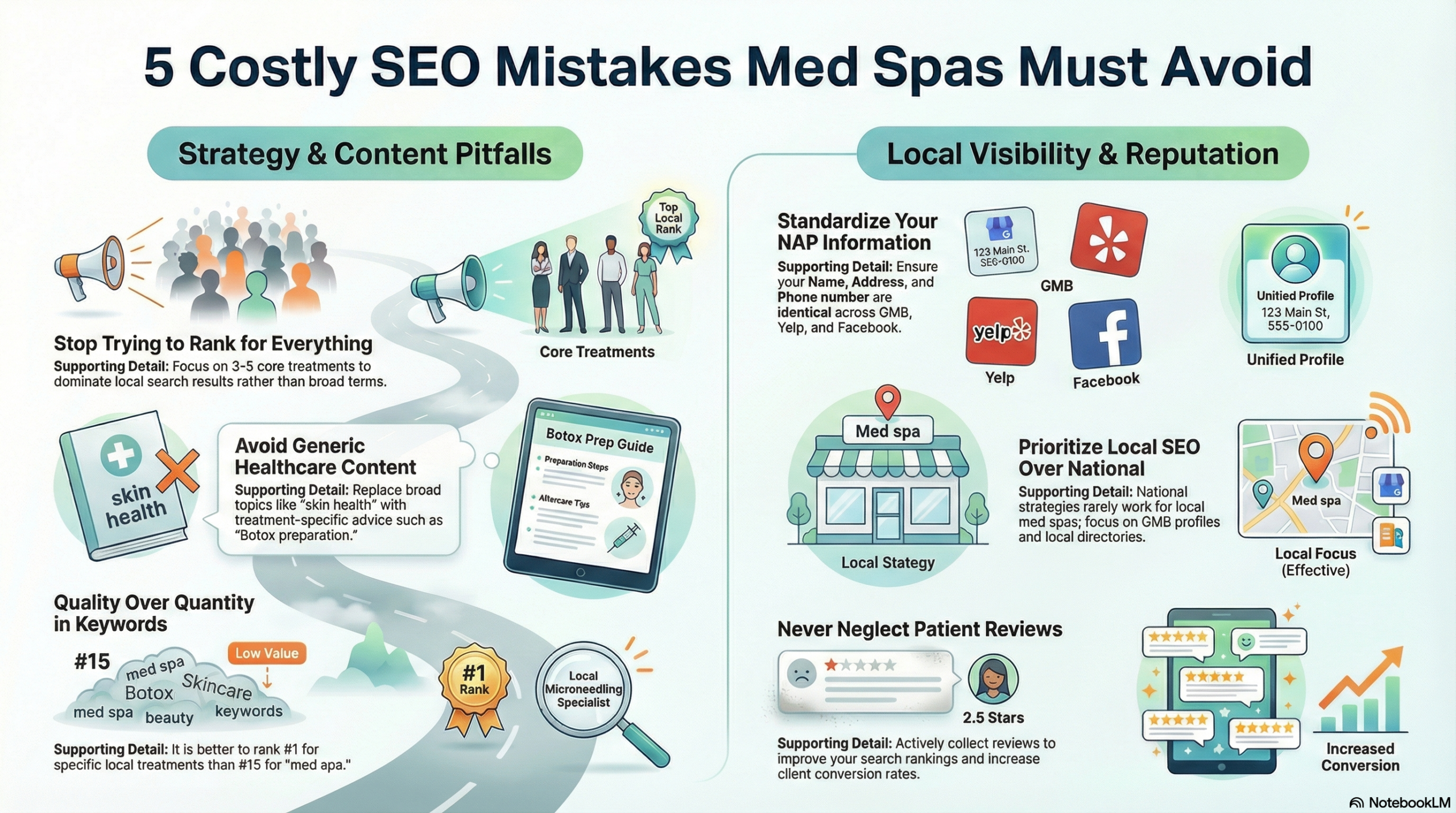
Mistake #1: Trying to Rank for Everything
Resist the urge to optimize for every possible keyword. Instead, focus on 3-5 core treatments and dominate those searches locally. It’s better to rank #1 for “Botox in [Your City]” than to rank #15 for “med spa.”
Mistake #2: Ignoring Local SEO
Med spas are inherently local businesses. National SEO strategies rarely work. Focus your efforts on local keywords, your GMB profile, and local directories.
Mistake #3: Generic Healthcare Content
Broad health and wellness content doesn’t convert med spa clients. Stay treatment-specific. Instead of writing about “skin health,” write about “the best treatments for hormonal acne” or “how to prepare for your first Botox appointment.”
Mistake #4: Inconsistent Business Information
Your name, address, and phone number must be identical everywhere—your website, GMB, Yelp, Healthgrades, Facebook, etc. Inconsistencies confuse Google and hurt rankings.
Mistake #5: Neglecting Reviews
Reviews directly impact rankings and conversion rates. If you’re not actively collecting reviews, you’re leaving money on the table.
Your Action Plan: Starting Your SEO Journey Today
If you’re overwhelmed by all this information, start here:
Week 1: Foundation (4-5 hours)
- Claim and verify your Google My Business profile
- Audit your current website for mobile-friendliness and speed
- Identify your top 5 core treatments to focus on
- Create a list of 15-20 local keywords
Week 2-4: Optimization (8-10 hours)
- Optimize your GMB profile with photos, keywords, and service descriptions
- Create or improve your top 3 service landing pages
- Set up Google Search Console and Google Analytics
- Ask 10 recent clients for reviews
Month 2: Content (10-15 hours)
- Write 4 blog posts answering common patient questions
- Create before-and-after galleries on your website
- Optimize internal links between your service pages
- Check and respond to all reviews
Month 3+: Maintain & Expand
- Monitor Google Search Console for ranking opportunities
- Continue adding blog content (aim for 1-2 posts per month)
- Maintain your GMB profile with regular posts
- Track your progress—measure rankings, traffic, and bookings
When to Hire Help:
- You’ve been trying for 3+ months and aren’t seeing results
- You lack time to implement (DIY takes 10-15 hours per month)
- You want faster results (agencies can compress timelines)
- Your competitors have already captured the local market
The Bottom Line
SEO isn’t magic, and it’s not overnight. But it’s one of the most powerful, cost-effective ways to grow a med spa. Unlike paid advertising that stops working the moment you stop paying, SEO compounds over time. Your investments today pay dividends for months and years to come.
The med spas winning in 2025 aren’t the ones with the biggest budgets—they’re the ones optimizing strategically for local search, building authority through content, and earning trust through reviews. They’re visible when potential clients search, they’re ranked higher than competitors, and they’re converting more browsers into bookers.
The question isn’t whether you can afford to do SEO. It’s whether you can afford NOT to.
Start with your Google My Business profile. That’s your foundation. Then build from there. You’ve got this.
Bonus Resources
- Free SEO Audit Template: Evaluate your current website’s health
- Keyword Research Spreadsheet: Track your priority keywords and rankings
- Content Calendar Template: Plan your blog posts for the next 90 days
- Review Request Email Templates: Easy-to-customize emails for soliciting reviews
Remember: SEO is a marathon, not a sprint. But every day your site isn’t optimized is a day a potential client finds your competitor instead. Start today, stay consistent, and watch your business grow.