

Executive Summary & Key Takeaways
Why SEO Matters for Law Firms Now If you’re reading this, there’s a good chance your potential clients are already searching for you on Google. According to 2025–2026 legal‑marketing research, over 96% of people seeking legal advice start with a search engine, and more than a quarter of those users are now directed toward hiring […]
Key Focus: Targeted search architecture optimized for high-intent conversions and AI engine discoverability.
Action Item: Implement structured entity schemas, direct answer blocks, and authority signal tracking.
Why SEO Matters for Law Firms Now
If you’re reading this, there’s a good chance your potential clients are already searching for you on Google.
According to 2025–2026 legal‑marketing research, over 96% of people seeking legal advice start with a search engine, and more than a quarter of those users are now directed toward hiring a lawyer via AI tools like Google’s AI Overviews, ChatGPT, and Perplexity.
SEO for law firms isn’t just about “ranking higher.” It’s about:
- Appearing when someone types “car accident lawyer near me” or “child custody attorney in [city]”
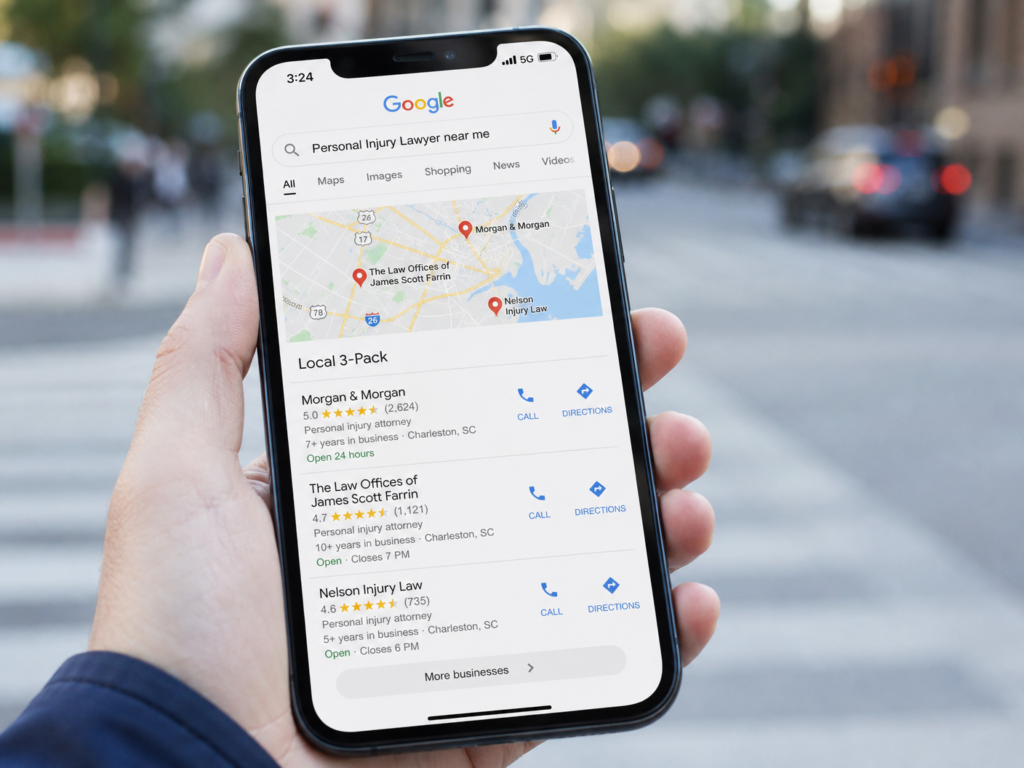
- Showing up in Google Maps and the local 3‑pack for location‑based searches
- Being cited in AI Overviews when someone asks an AI assistant, “Who should I hire for a personal injury case?”
In this 3,000+‑word guide, you’ll learn how to build a 2026‑ready SEO strategy that:
- Attracts high‑intent clients
- Builds trust and topical authority in your practice area
- Optimizes for AI search, semantic SEO, and EEAT so your firm shows up in Google’s AI‑powered answers
This same framework — local SEO, content, and AEO/GEO layered together — is what I apply across every high‑trust niche; see the Industry-Specific SEO guide for how it plays out beyond legal.
What is SEO for Law Firms?
SEO for law firms means optimizing your website and online presence so that your firm shows up higher in Google when people search for:
- “Divorce lawyer Kolkata”
- “best criminal defense attorney near me”
- “slip and fall lawyer [city]”
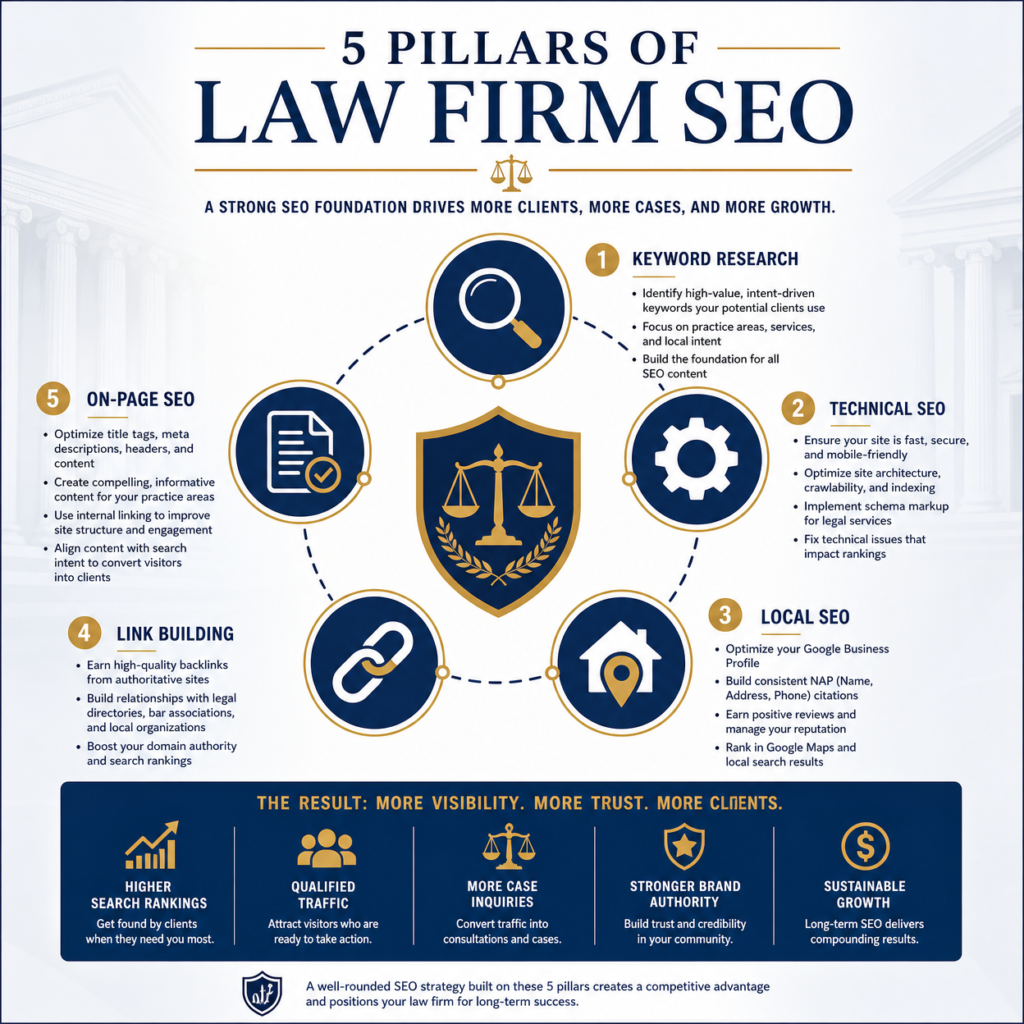
In practice, lawyer SEO combines five core components:
- Keyword research – Finding the exact phrases real clients type into Google.
- On‑page SEO – Optimizing titles, headings, content structure, and internal links.
- Technical SEO – Fixing site speed, mobile‑friendliness, security, and crawlability.
- Local SEO & Google Business Profile – Ranking in Google Maps and local search.
- Link building & authority signals – Earning backlinks from reputable legal sources.
Your end goal is simple: turn your website into a 24/7 lead‑generation channel that continues to send you clients long after you stop paying for ads.
Why is SEO important for lawyers in 2026?
Google’s 2025–2026 updates have made high‑intent legal searches one of the most competitive verticals on the web.
- Page 1 = visibility – The #1 organic result captures roughly 27–40% of all clicks, while results beyond page 1 get less than 1%.
- Local searches dominate – 42% of legal searchers click on a result inside the Google local 3‑pack, and those firms get over 90% more conversion actions (calls, directions, website visits) than firms ranked 4–10.
- AI Overviews reshape traffic – AI‑powered answers now appear on a large share of search queries, and organic CTR drops by over 60% on those pages unless your site is cited in the Overview.
For law firms, that means:
- Not ranking organically = giving your cases to competitors.
- Not optimizing for AI search = losing to firms that show up inside AI answers.
How Potential Clients Search for Lawyers Online
Before you start SEO, you must understand how people actually search for legal help.
Real‑world search patterns break down into three buckets:
1. Informational queries
Users are still learning:
- “What is the statute of limitations for car accidents in [state]?”
- “Can I modify child custody if I move to another city?”
These queries don’t always convert immediately, but they help you establish topical authority and appear in AI Overviews.
2. Commercial‑intent queries
Users are comparing firms:
- “best family lawyer in [city]”
- “top personal injury law firm near me”
These signals high purchasing intent and are prime targets for your practice‑area landing pages.
3. Branded & navigational queries
Users already know your firm:
- “Debojyoti Ghosh law firm”
- “Ghosh Family Law reviews”
These queries are crucial because share of branded search strongly correlates with market share.
Keyword Research for Law Firms
What are the best keywords for law firms?
Good law firm keywords balance search volume, competition, and intent.
Effective keyword categories include:
- Practice‑area + location
- “criminal defense lawyer Kolkata”
- “family law attorney Mumbai”
- Specific problem + “near me”
- “hit and run lawyer near me”
- “domestic violence attorney near me”
- Long‑tail questions
- “what happens if I get charged with DUI in [state]?”
- “how to file for divorce without going to court?”
Use tools like Ahrefs, Semrush, or Google Keyword Planner to:
- Identify search volume
- Check difficulty
- Analyze competitor pages
Pro tip:
Create a keyword map sheet where each practice area (e.g., personal injury, family, criminal defense) has its own tab, with:
- Target keyword
- Secondary / long‑tail keywords
- Existing page URL
- Competitor URLs
This makes your SEO planning repeatable and scalable.
Local SEO for Lawyers
Local SEO is the core of most law firm SEO strategies.
Because legal services are location‑based, Google wants to see:
- NAP consistency – Name, address, phone number identical everywhere
- Local relevance – Content that speaks to a specific city or region
- Social proof – Reviews, ratings, and local citations
Does local SEO work for lawyers?
Yes – and often better than national SEO.
Research shows:
- Local search drives the majority of calls for law firms
- Firms in the Google Maps 3‑pack get far more website clicks, calls, and direction requests than those outside it
Actionable local‑SEO tactics:
- Own your Google Business Profile in the right category
- Build NAP listings on Avvo, Justia, FindLaw, Martindale‑Hubbell, and other legal‑specific directories
- Create dedicated city‑ and practice‑area pages, not generic “Law Firm” templates
Google Business Profile optimization for law firms
Your Google Business Profile (GBP) is the single most powerful local‑SEO lever for attorneys.
Follow this checklist:
Category – Use the most specific option (e.g., “Personal Injury Attorney,” “Family Law Attorney”) as your primary category.
Description – Fill the full 750‑character description with:
- What practice areas you serve
- Who you help
- Why clients choose you over others
Service list – Add individual services (e.g., “Car Accident Lawsuits,” “Divorce Mediation”).
Photos & posts – Upload recent office photos, team photos, and weekly posts that highlight events, case results (within ethics rules), and community involvement.
Hours & contact info – Keep accurate hours and phone number.
Reviews – Respond to every review within 24‑48 hours.
Remember:
- 82% of people check reviews before hiring a lawyer.
- Google’s 2026 algorithm heavily favors active, “alive” GBP profiles and filters out stale ones from both Maps and AI‑generated answers.
Content Marketing for Attorneys
How can lawyers rank higher on Google?
Google rewards high‑quality, authoritative, audience‑focused content in legal:
To rank higher, build content around three pillars:
- Practice‑area landing pages
- Target commercial‑intent keywords (e.g., “workers’ compensation lawyer Chicago”).
- Include clear CTAs, contact forms, and phone numbers.
- City‑ and region‑specific pages
- “Car accident lawyer Miami,” “slip and fall attorney Orlando,” etc.
- Mention local courts, traffic patterns, and common accident types.
- Educational blog content (“topical authority”)
- Answer question‑based queries like:
- “why hire a personal injury lawyer?”
- “what happens after a DUI arrest?”
- Answer question‑based queries like:
Each page should:
- Use question‑based H2/H3 headings for AI and featured snippets
- Be skimmable with short paragraphs, bullet points, and clear structure
- Include author bios with real attorney credentials (bar, years of experience, case results within ethics rules)
Semantic SEO & Topical Authority
Semantic SEO means organizing your site so Google sees you as a true authority in a specific topic.
Instead of writing 50 random blog posts, think in topic clusters:
- Core pillar page – “Personal Injury Law [City]”
- Targets the main commercial keyword
- Cluster pages – “Car Accident Lawsuits,” “Truck Accident Claims,” “Bicycle Accident Compensation,” etc.
- Each page links back to the pillar and to other cluster pages
Google’s AI systems prefer self‑contained, semantically rich answers of roughly 50–170 words in clear sections.
Semantic‑SEO best practices:
- Use LSI‑style synonyms naturally (e.g., “compensation,” “settlement,” “payout”)
- Structure content with question‑style headings
- Support claims with data, citations, and case‑study‑style explanations (without revealing confidential info)
This makes your site more likely to appear in AI Overviews and featured snippets — the same principles covered in our guide to Answer Engine Optimization.
Technical SEO for Law Firm Websites
Technical SEO ensures Google can find, crawl, and understand your site.
Core technical‑SEO checks:
- Site speed – Aim for under 2 seconds on mobile. Slow pages increase bounce rates and hurt rankings.
- Mobile‑first design – Over 60% of legal searches are done on mobile devices.
- SSL (HTTPS) – Non‑HTTPS sites are marked as insecure and lose trust.
- Structured data / schema – Use:
- Organization
- LocalBusiness / Attorney
- FAQ and How‑to schema for educational content
- No duplicate content – Avoid copying boilerplate text across practice‑area pages.
- Fix crawl errors – Use Google Search Console to find and fix 404s, 5xx errors, and index‑blocked pages.
Recommended schema markup types for your article:
- Article – for this blog post itself
- FAQPage – for the FAQ section
- Organization and LocalBusiness – for your law‑firm section on your site
For a deeper walkthrough of implementation, see our guide to structured data and schema markup for answer engines.
EEAT for Legal Websites
In 2026, EEAT (Experience, Expertise, Authoritativeness, Trustworthiness) is the #1 ranking lever for law‑firm sites.
Because legal content is You‑Money‑or‑Your‑Life (YMYL), Google expects:
- Clear authorship – Show attorney bios with real names, bar numbers, and practice‑area focus.
- Accurate, verified information – Cite statutes, case‑law patterns, and recent changes (without giving formal legal advice).
- Evidence of experience – Highlight years in practice, recognitions, and ethical case‑handling standards.
- Transparency – Disclosures, privacy policy, and disclaimers (e.g., “not legal advice”).
To boost EEAT:
- Have attorneys write or review every practice‑area and FAQ page
- Use byline sections linking to individual attorney profiles
- Add case‑study‑style explanations (without breach of confidentiality) that show how you solved real‑world problems

Link Building for Lawyers
How do law firms get clients from Google?
Organic links and brand authority are the silent engines behind your Google rankings.
Focus on quality, not quantity:
- Legal‑industry publications – Guest articles in bar‑association blogs, legal‑marketing sites, or niche legal‑news outlets
- Local news sites – Commentary on local reforms, high‑profile cases, or community events
- Local organizations – Chambers of commerce, nonprofits, and scholarship programs you sponsor
- University‑law‑school collaborations – Mentoring, guest lectures, or sponsored events
One high‑authority link from a state‑level bar site is worth far more than 50 generic directory links.
Avoid:
- PBNs (Private Blog Networks) – Risky and often penalized
- Low‑quality directory spam – Google ignores these and can flag them as spammy
AI Overviews & AI Search Optimization
Can AI search impact law firm SEO?
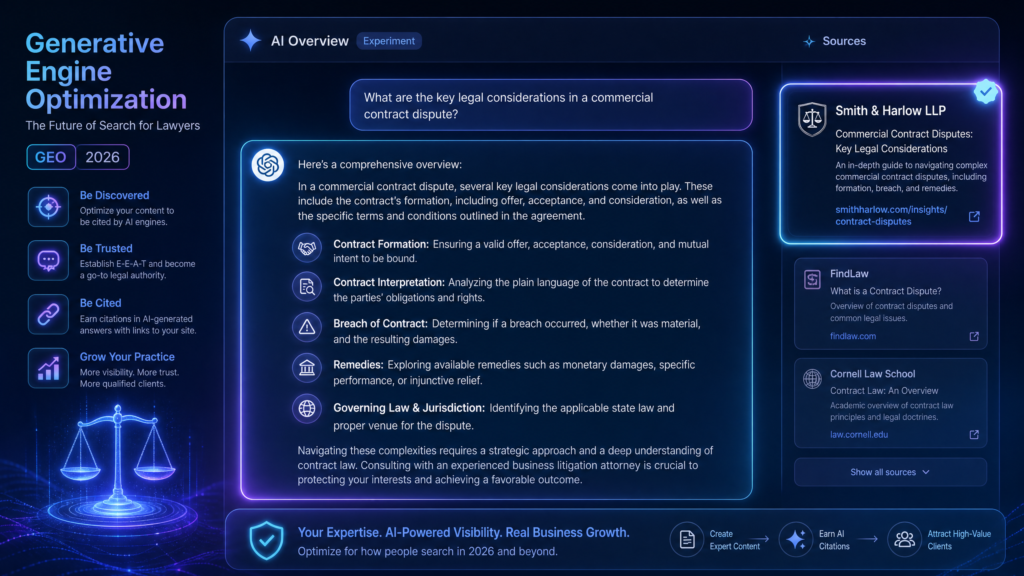
Absolutely. AI Overviews (formerly SGE) now trigger on a large share of Google searches, and they’re reshaping how people discover lawyers. This entire layer is what my AEO services and GEO services are built to handle for firms that don’t have time to structure this themselves.
Key facts:
- When AI Overviews appear, organic CTR drops by about 60% unless your page is cited in the answer.
- If your site is cited, it can earn 35% more organic clicks and 91% more paid clicks, according to industry tracking.
How to appear in AI Overviews
To show up in AI Overviews and similar tools (ChatGPT, Perplexity, Gemini), focus on:
- Structured, question‑based content
- Use clear H2/H3 headings that match natural questions
- Under each heading, provide a self‑contained 50‑170 word answer
- Schema‑rich formatting
- Mark up FAQs with FAQ schema
- Use Article and How‑to schema where relevant
- First‑hand experience and authority
- Google’s AI Overviews heavily favor real‑attorney‑authored content with visible credentials
- Avoid generic AI‑written content that lacks EEAT signals
- Fresh, verifiable data
- Mention recent legal changes, statistics, and local‑specific details (e.g., “Kolkata had over X road accidents in 2025”)
SEO vs Google Ads for Attorneys
Is SEO better than Google Ads for lawyers?
Short answer: SEO complements Google Ads; in most cases, you want both.
Here’s a simplified comparison:
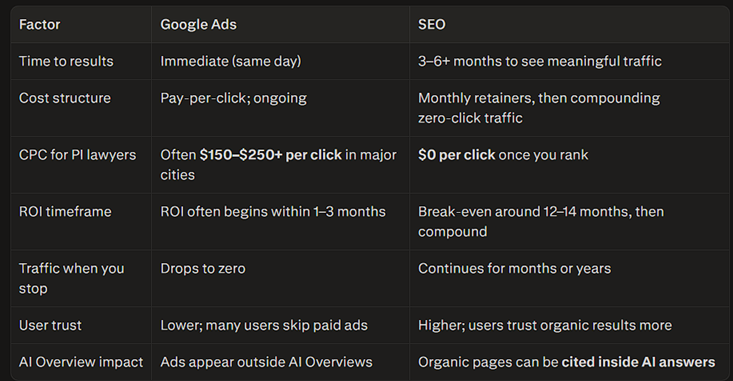
Smart law firms use Google Ads to capture demand now while SEO builds long‑term authority and lower customer‑acquisition cost.
How Long Does Law Firm SEO Take?
How long does SEO take for law firms?
Most firms see:
- 2‑3 months – First rankings for long‑tail keywords
- 3‑6 months – Meaningful traffic and lead increases
- 12‑24 months – Strong, compounding results on competitive keywords
Speed depends on:
- Market competitiveness (e.g., personal injury in big cities vs. mid‑sized cities)
- Your current website health
- How aggressively you invest (content, links, GBP, etc.)
How much does SEO for attorneys cost?
Estimates vary, but common ranges:
- Small or solo firms – Around $2,500‑$5,000/month
- Mid‑size firms – $8,000‑$15,000/month
- Large or competitive PI firms – $15,000‑$30,000+/month
A good rule of thumb:
Allocate about 10‑12% of gross revenue to marketing, with SEO as a major share in competitive markets.
Common SEO Mistakes Law Firms Make
Avoid these pitfalls:
- Ignoring EEAT – Generic, AI‑only content that offers no real‑attorney expertise
- Copying competitors’ pages – Duplicate content hurts rankings and trust
- Skipping local SEO – Not optimizing GBP or NAP citations
- Ignoring AI search – Not structuring content for AI Overviews and semantic search
- Stopping after 3‑4 months – SEO is a long‑term play; many firms quit before they see results
What Is the Best Marketing Strategy for a Law Firm?
The best marketing strategy combines:
- SEO + Local SEO – For consistent, high‑intent organic traffic
- Google Ads – For immediate case volume and testing new markets
- Content marketing – Blogs, FAQs, and AI‑optimized content to build authority
- Reputation management – Reviews, testimonials, and active GBP responses
- Community presence – Local events, pro‑bono work, and thought‑leadership articles
- SEO is the anchor of this strategy because it scales and doesn’t stop when you stop paying.
Law Firm SEO FAQs
1.What is SEO for law firms?
SEO for law firms is the process of optimizing your website and online presence so that your practice appears in Google when people search for legal services in your area.
2. Why is SEO important for lawyers?
Because most potential clients start by searching on Google, and firms that rank higher capture significantly more clicks and leads than those on page two or beyond.
3. How long does law firm SEO take?
Most firms see meaningful traffic growth between 3‑6 months, with compounding results over 12‑24 months, depending on market competitiveness.
4. Is SEO better than Google Ads for lawyers?
SEO builds long‑term, compounding traffic while Google Ads delivers immediate but stop‑pable results. Many firms use both, with SEO as the core growth channel.
5. How important are reviews for attorney SEO?
Reviews strongly influence local rankings and client trust; 82% of people check reviews before hiring a lawyer, and Google weighs review volume and recency heavily.
Conclusion:
In 2026, SEO for law firms is no longer optional—it’s the central engine of growth for most practices.
When you combine:
- Smart keyword research
- EEAT‑driven content
- Local SEO and Google Business Profile optimization
- Technical SEO and semantic‑search‑friendly structure
- Authority‑building link‑building and AI‑Overview optimization
You create a system where your website continuously sends you high‑intent leads from Google, Maps, and AI‑powered search tools.
If you’re a lawyer or law‑firm owner reading this, you have two options:
- Let your competitors dominate Google while you rely only on referrals.
- Or, start building a deliberate, 2026‑ready SEO strategy that turns your website into a lead‑generation engine.