
Executive Summary & Key Takeaways
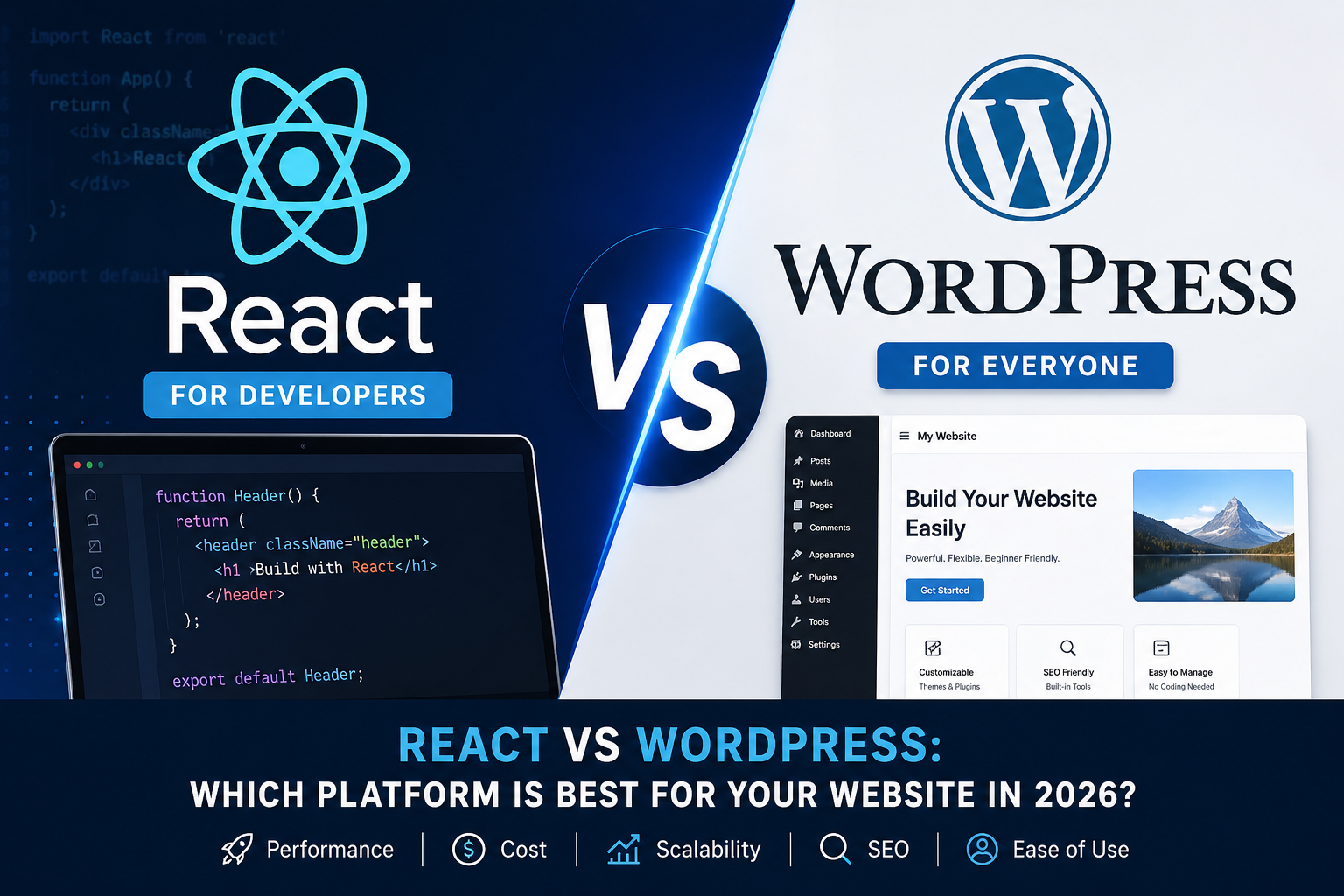
Choosing the right platform for your website can make or break your online success. Two of the most popular options today are React and WordPress. But which one is actually better for your business? The answer isn’t one-size-fits-all – it depends on your goals, budget, and technical needs. In this guide, we’ll break it down […]
Key Focus: Targeted search architecture optimized for high-intent conversions and AI engine discoverability.
Action Item: Implement structured entity schemas, direct answer blocks, and authority signal tracking.
Choosing the right platform for your website can make or break your online success. Two of the most popular options today are React and WordPress.
But which one is actually better for your business?
The answer isn’t one-size-fits-all – it depends on your goals, budget, and technical needs. In this guide, we’ll break it down in a simple, practical way so you can make the right decision.
Whether you’re a startup founder, a small business owner, or someone with zero coding experience, this guide breaks down everything you need to know: what each platform does, how they compare, and most importantly – which one is right for you.
What is React?
React is an open-source JavaScript library developed by Meta (formerly Facebook) in 2013. It used to build fast, dynamic, and highly interactive web applications.
It’s mainly used by developers to create:
- Custom web applications
- SaaS platforms
- High-performance dashboards
- Complex user interfaces
React gives full control – but requires coding knowledge.
Popular websites built with React: Facebook, Instagram, Airbnb, Netflix, Dropbox.
Quick Answer: React is a JavaScript library for building high-performance, custom web applications. It requires developer expertise to use effectively.
What is WordPress?
WordPress is the world’s most popular website-building platform, powering over 40% of websites globally. Originally launched in 2003 as a blogging platform, it has evolved into a full-featured website builder suitable for blogs, business websites, eCommerce stores, and more.
It allows you to:
- Build websites without coding
- Manage content easily
- Use themes and plugins
- Launch quickly
WordPress is beginner-friendly and business-focused.
Popular websites built with WordPress: TechCrunch, The New York Times blogs, BBC America, Sony Music.
Quick Answer: WordPress is a beginner-friendly CMS that lets anyone build a professional website quickly, without needing technical skills.
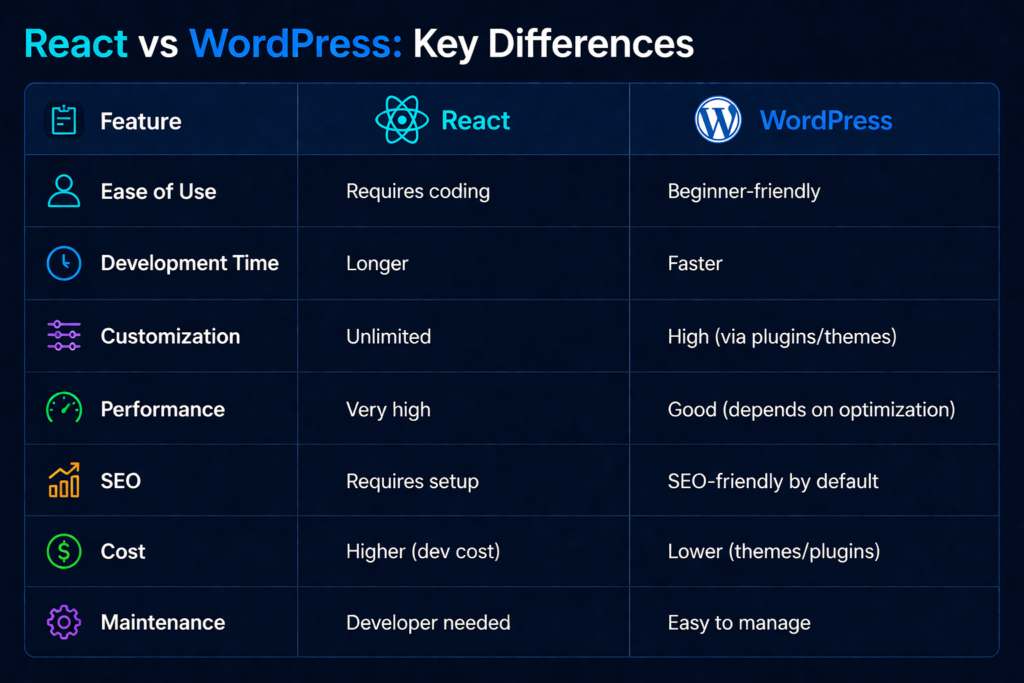
React vs WordPress: Key Differences
Pros and Cons
✅ React Pros
- Extremely fast performance
- Highly scalable
- Full customization
- Ideal for complex applications
❌ React Cons
- Requires skilled developers
- Higher development cost
- Not beginner-friendly
- SEO needs extra setup
✅ WordPress Pros
- Easy to use
- Quick to launch
- Cost-effective
- SEO-friendly
- Huge plugin ecosystem
❌ WordPress Cons
- Limited compared to fully custom apps
- Can slow down if poorly optimized
- Plugin dependency
React vs WordPress: Detailed Comparison
1. Ease of Use
WordPress wins easily. You can manage everything from a dashboard without coding. React requires technical expertise.
2. Performance
- React is faster by default because it’s built for dynamic applications.
- However, a well-optimized WordPress site can also perform extremely well.
3. SEO Capabilities
- WordPress is naturally SEO-friendly with plugins like Yoast or RankMath.
- React needs additional setup (SSR, frameworks like Next.js) for proper SEO.
4. Cost
- React → Higher (developer + time)
- WordPress → Lower (themes + plugins)
5. Scalability
- React is ideal for large-scale applications.
- WordPress works best for business websites, blogs, and eCommerce.

When to Choose React
React is the right choice when:
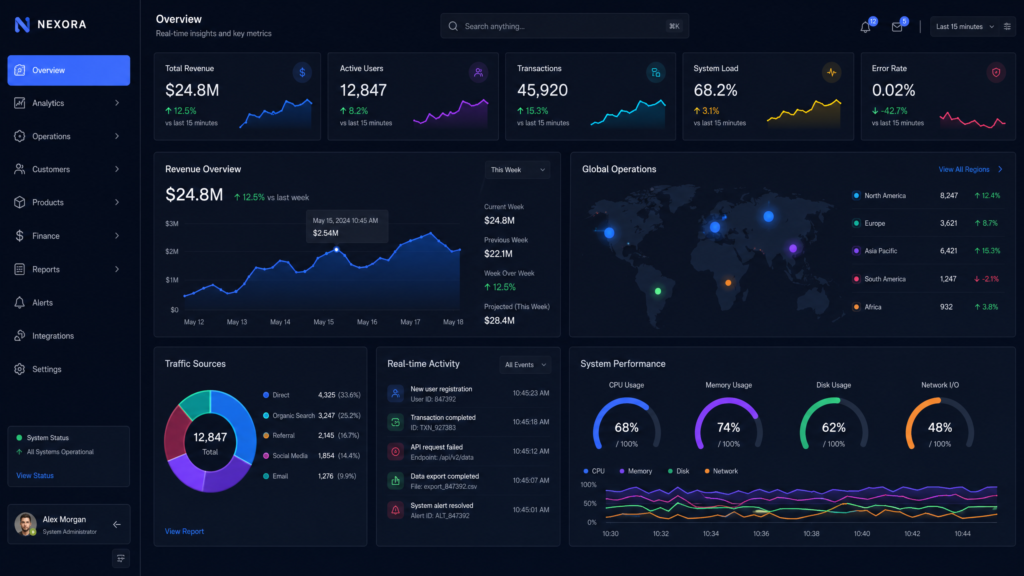
- You’re building a SaaS product – dashboards, CRMs, project management tools, or fintech apps that require dynamic, real-time interfaces.
- Your application handles complex user interactions – think multi-step forms, live data feeds, drag-and-drop interfaces, or real-time collaboration tools.
- You need enterprise-level scalability – platforms expecting millions of users or needing microservices architecture.
- You have a dedicated development team – or budget to hire experienced React/Next.js developers.
- You’re building a custom eCommerce experience — beyond what Shopify or WooCommerce can offer.
Real-World Example: A startup building a B2B project management platform (like Asana or Trello) would choose React for its performance, real-time updates, and the ability to build a product that feels like a native application.
When to Choose WordPress
WordPress is the right choice when:
- You’re launching a business website or portfolio — fast, affordable, and professional without developer dependency.
- You need a blog or content-driven website — WordPress is the gold standard for publishing workflows and SEO.
- You’re running a small-to-medium eCommerce store — WooCommerce handles product listings, payments, and inventory with ease.
- You have a limited budget — WordPress dramatically reduces both launch costs and ongoing management costs.
- Your team is non-technical — marketing staff can update content, add pages, and run campaigns independently.
Real-World Example: A local law firm, a restaurant, or an online coaching business launching their first website in 2026 should choose WordPress. They can go live in under a week, update their own content, and rank on Google without needing a developer on retainer.

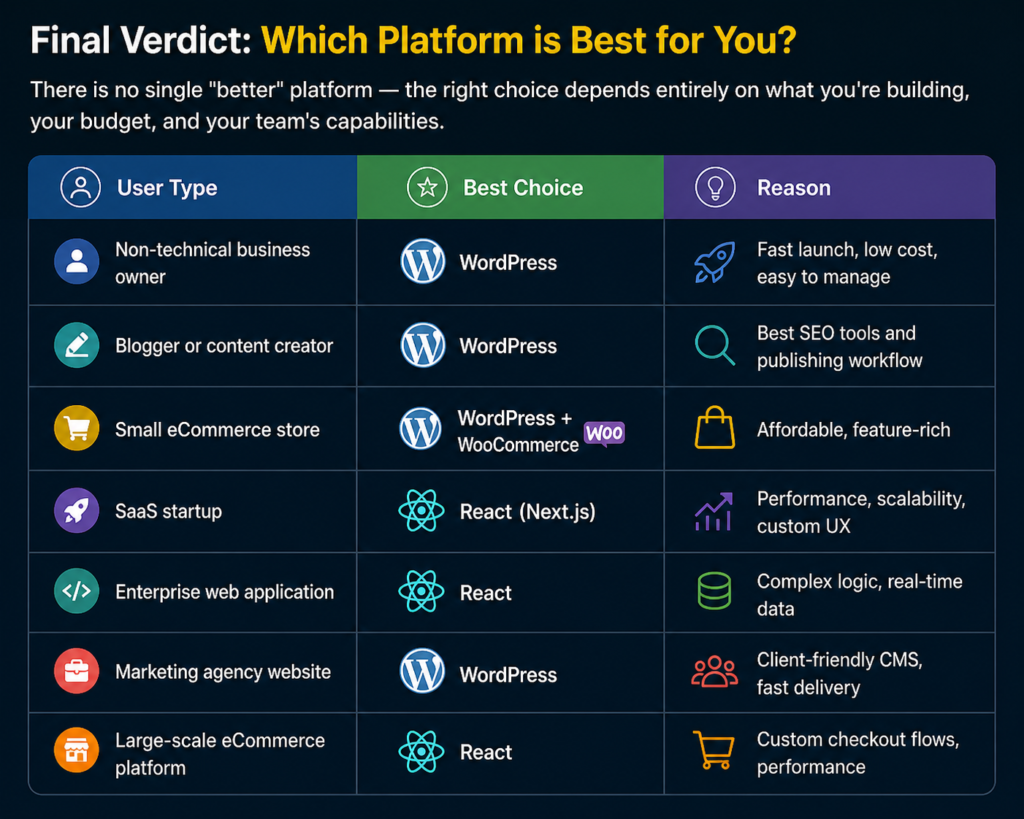
Final Verdict: Which Platform is Best for You?
There is no single “better” platform — the right choice depends entirely on what you’re building, your budget, and your team’s capabilities.
| User Type | Best Choice | Reason |
|---|---|---|
| Non-technical business owner | WordPress | Fast launch, low cost, easy to manage |
| Blogger or content creator | WordPress | Best SEO tools and publishing workflow |
| Small eCommerce store | WordPress + WooCommerce | Affordable, feature-rich |
| SaaS startup | React (Next.js) | Performance, scalability, custom UX |
| Enterprise web application | React | Complex logic, real-time data |
| Marketing agency website | WordPress | Client-friendly CMS, fast delivery |
| Large-scale eCommerce platform | React | Custom checkout flows, performance |
Bottom line: If you’re a business owner who wants a website that works great, looks professional, and won’t drain your budget — WordPress is your answer in 2026. If you’re building a product, an app, or a platform that needs to compete with the best in tech — React (with Next.js) is the way to go.
Frequently Asked Questions (FAQs)
1. What is the difference between React and WordPress?
React is a JavaScript library used by developers to build interactive web applications and user interfaces. WordPress is a content management system that allows anyone — with or without coding skills — to build and manage a website. React is for building apps; WordPress is for building websites.
2. Is WordPress easier than React?
Yes, significantly. WordPress has a visual editor and requires no coding for most tasks. React requires knowledge of JavaScript, component-based architecture, and often additional frameworks like Next.js. For non-developers, WordPress is the clear choice.
3. Can React replace WordPress?
React can replace WordPress for certain use cases — particularly complex web applications and SaaS platforms. However, for content-heavy websites, blogs, and standard business sites, WordPress remains more practical and cost-effective. They solve different problems and are not direct substitutes.
4. Is React better than WordPress for SEO in 2026?
Not inherently. WordPress offers better out-of-the-box SEO tools (Yoast SEO, Rank Math, automatic sitemaps). React requires additional configuration — specifically server-side rendering via Next.js — to achieve comparable SEO performance. For most businesses, WordPress is the easier path to strong search rankings.
5. Which is better for an eCommerce website — React or WordPress?
For small-to-medium eCommerce businesses, WordPress with WooCommerce is the smarter, faster, and more affordable choice. For large-scale platforms with custom checkout flows, personalization engines, and high-traffic demands, React (often combined with headless commerce tools like Shopify Hydrogen or Medusa.js) delivers superior performance.
6. Should a startup use React or WordPress?
It depends on what the startup is building. If you’re launching a SaaS product, internal tool, or data-driven platform — use React. If you’re building a marketing website, landing page, or blog to drive leads — use WordPress. Many startups actually use both: WordPress for their marketing site, React for their product.
7. Which platform is more secure — React or WordPress?
React applications, when properly built, tend to have fewer security vulnerabilities because they have a smaller attack surface and no plugin ecosystem to patch. WordPress security depends on discipline: keeping WordPress core, themes, and plugins updated, using a security plugin like Wordfence, and choosing reputable hosting. Both can be secure when maintained properly.
Need Help Choosing the Right Platform?
If you’re confused about which platform is right for your business, I can help you decide and build a high-performing website tailored to your goals.