
Executive Summary & Key Takeaways
The Complete Guide to Growing Your Dental Practice Online Let us be honest, running a dental practice is hard enough without worrying about whether patients can find you online. If you have ever wondered why your competitor’s practice shows up first on Google while yours is buried on page three, you are not alone. The […]
Key Focus: Targeted search architecture optimized for high-intent conversions and AI engine discoverability.
Action Item: Implement structured entity schemas, direct answer blocks, and authority signal tracking.
The Complete Guide to Growing Your Dental Practice Online
Let us be honest, running a dental practice is hard enough without worrying about whether patients can find you online. If you have ever wondered why your competitor’s practice shows up first on Google while yours is buried on page three, you are not alone. The good news?
SEO for dentists is not some mysterious black box. It is a set of practical strategies that can help your practice show up exactly when potential patients are searching for dental services in your area.
Whether you are running a solo practice or managing multiple locations, this guide will walk you through everything you need to know about dental SEO, in plain English, without the technical jargon. This same playbook applies across high-trust, high-consideration niches — see how it plays out for med spas and beauty salons and spas in the Industry-Specific SEO guide.
What is SEO for Dentists?
Search Engine Optimization (SEO) is the process of making your dental practice more visible in search engine results. When someone in your area searches for “dentist near me” or “emergency dental care,” you want your practice to appear at the top of those results.
Think of SEO as digital word-of-mouth. Just like referrals help grow your practice, good SEO helps search engines recommend your practice to people actively looking for dental services.
Why SEO Matters for Your Dental Practice
Here is what most dentists do not realize: over 77% of patients use search engines before booking a dental appointment. If your practice is not showing up in those searches, you are missing out on a steady stream of new patients.
Local SEO for dentists is especially critical because most dental patients search within a 5-mile radius of their home or workplace. That means you are not competing with every dentist in the country, just the ones in your neighbourhood.
And unlike paid advertising, which stops working the moment you stop paying, SEO builds long-term visibility that keeps bringing in new patients’ month after month.
Understanding Local SEO for Dentists
When someone searches for dental services, Google prioritizes businesses that are nearby and relevant. This is where local SEO becomes your best friend.
Optimize Your Google Business Profile
Your Google Business Profile (formerly Google My Business) is the single most important tool for local dental SEO. It is what makes your practice appear in Google Maps and the local pack, that box of three businesses that shows up at the top of local searches.
Here is what you need to do:
- Claim and verify your listing if you have not already
- Complete every section, practice name, address, phone number, hours, services
- Add high-quality photos of your office, team, and even patient-friendly treatment rooms
- Choose the right categories: “Dentist” as primary, plus specialties like “Cosmetic Dentist” or “Paediatric Dentist” if applicable
- Keep your information consistent across all online platforms
Why Patient Reviews Are SEO Gold
Google loves fresh reviews. Practices with more positive reviews tend to rank higher in local search results. Plus, let us face it, patients trust other patients more than they trust your marketing copy.
The key is to make leaving a review as easy as possible. Send follow-up emails after appointments with a direct link to your Google review page. Do not be shy about asking, most satisfied patients are happy to help.
And when you get a negative review? Respond professionally and promptly. It shows potential patients that you care about their experience.
Finding the Right SEO Keywords for Dentists
Keywords are the search terms people type into Google. If you want to show up when patients search, you need to understand what they are searching for. But here is the thing, not all keywords are created equal.
Focus on Location-Based Keywords
Generic terms like “dentist” are too competitive and too broad. Instead, focus on
local keywords that include your city or neighbourhood:
- “dentist in [your city]”
- “emergency dentist near me”
- “cosmetic dentist [neighborhood]”
- “pediatric dentist [city]”
- “teeth whitening [your area]”
Service-Specific Keywords That Convert
People searching for specific services often have higher intent to book. These are gold for your practice:
- “dental implants [city]”
- “Invisalign provider near me”
- “root canal specialist [area]”
- “teeth cleaning [neighborhood]”
- “same-day dental crowns”
Use these keywords naturally throughout your website content, service pages, and blog posts.
Optimizing Your Dental Website for SEO
Your website is your digital storefront. If it is not optimized for search engines, you’re making it harder for patients to find you.
Here is what matters most:
Make Your Site Fast
Page speed is a ranking factor. If your site takes more than 3 seconds to load, you are losing patients. Google’s PageSpeed Insights tool can help you identify what is slowing you down.
Common fixes include compressing images, using a content delivery network (CDN), and choosing a reliable web host.
Mobile-Friendly is Non-Negotiable
Over 60% of dental searches happen on mobile devices. If your website doesn’t look good and work well on phones, you are turning away more than half your potential patients.
Mobile optimization means easy-to-tap buttons, readable text without zooming, and fast load times on cellular networks.
Simple Navigation and Clear CTAs
Make it ridiculously easy for patients to book an appointment. Your phone number should be visible on every page, and your “Book Now” button should stand out.
Create dedicated pages for each service you offer, this helps you rank for specific treatments like “dental implants” or “teeth whitening.”
Creating Content That Ranks (and Helps Patients)
Content isn’t just blog posts for the sake of blog posts. Good
dental content answers the questions your patients are asking.
Blog Topics That Attract Patients
Write about topics that address patient concerns:
- “What to Expect During Your First Visit”
- “How Much Do Dental Implants Cost?”
- “5 Signs You Need to See a Dentist Immediately”
- “Teeth Whitening: Professional vs. At-Home Options”
- “How to Choose the Right Dentist for Your Family”
Each post should include your target keywords naturally, answer questions thoroughly, and include a clear call-to-action to schedule an appointment.
Service Pages That Convert
Every service you offer should have its own dedicated page. This isn’t just good for SEO—it helps patients understand what you offer.
Each service page should include:
- Clear description of the treatment
- Benefits and outcomes patients can expect
- Before and after photos (if applicable)
- Pricing information or insurance details
- Prominent booking button
Technical SEO Basics for Dental Websites
Don’t worry, you don’t need to be a tech expert. But there are a few technical elements that can make or break your SEO efforts.
If this feels overwhelming, it’s worth hiring a professional to handle the technical side while you focus on running your practice.
Use Schema Markup
Schema markup is code that helps search engines understand your content better. For dentists, this means adding structured data about your practice hours, services, location, and reviews.
It sounds complicated, but many website builders and SEO plugins can add this automatically. Our guide to structured data and schema markup covers this in more depth, including how it feeds AI answer engines.
Secure Your Site with HTTPS
Google prioritizes secure websites. If your URL starts with “http” instead of “https,” you need an
SSL certificate. Most web hosts offer this for free or a small fee.
Fix Broken Links and Errors
Broken links frustrate visitors and hurt your SEO. Use tools like Google Search Console to identify and fix 404 errors on your site.
Set up redirects for any old pages you’ve deleted or moved so you don’t lose the SEO value they built up.
Building Authority Through Quality Backlinks
Backlinks links from other websites to yours, are like votes of confidence. The more high-quality sites that link to you, the more Google trusts your practice.
But quality matters more than quantity. One link from a reputable health website is worth more than 100 links from random directories.
Get Listed in Reputable Directories
Make sure your practice is listed on:
- Healthgrades
- ZocDoc
- Yelp
- Local Chamber of Commerce
- Better Business Bureau
Keep your
NAP (Name, Address, Phone) information consistent across all listings.
Partner with Local Businesses
Sponsor local events, sports teams, or charities. Many organizations will link to your website from theirs, giving you valuable local backlinks.
Consider guest posting on local health blogs or collaborating with other healthcare providers in your area.
Should You Hire SEO Services for Dentists?
Here’s the truth: you can do SEO yourself, but it takes time, effort, and ongoing learning.If you’re running a busy practice, hiring SEO services for dentists or working with an SEO company for dentists might be the smarter investment.
What to Look for in an SEO Provider
If you decide to hire help, look for:
- Experience with dental practices specifically
- Transparent reporting and monthly updates
- White-hat techniques (no shady shortcuts)
- Local SEO expertise, not just general SEO
- Clear communication about what they are doing and why
Ask for case studies or examples of dental practices they have helped grow. If they can’t show results, keep looking.
Tracking Your SEO Results
SEO isn’t a “set it and forget it” strategy. You need to track what’s working and what isn’t.
The good news? You don’t need expensive tools to get started.
Use Google Analytics
Google Analytics (free) shows you:
- How many people visit your site
- Where they are coming from (search, social, direct)
- Which pages they visit most
- How long they stay on your site
Monitor Google Search Console
Google Search Console (also free) tells you:
- Which keywords bring people to your site
- Your average position in search results
- Technical errors that need fixing
- How many people see your site in search results
Track Phone Calls and Appointment Bookings
At the end of the day, what matters most is whether your SEO efforts bring in new patients.
Use call tracking software to see which marketing channels (including organic search) drive the most phone calls. Monitor your online booking system to see where appointment requests are coming from.
If you’re seeing more organic traffic but not more appointments, you might have a conversion problem, not an SEO problem.
Common SEO Mistakes Dentists Make (And How to Avoid Them)
Even with the best intentions, it’s easy to make mistakes that hurt your rankings. Here are the most common ones I see:
Ignoring Mobile Users
If your site isn’t mobile-friendly, you are losing patients. Period. Test your site on multiple devices and make sure everything works smoothly.
Keyword Stuffing
Yes, keywords matter. But cramming “dentist in Phoenix” into every sentence makes your content sound robotic and hurts your rankings.
Use keywords naturally. Write for humans first, search engines second.
Copying Content from Other Sites
Google penalizes duplicate content. Don’t copy text from your competitors or use generic templates without customization.
Your content should be unique to your practice and genuinely helpful to your patients.
Inconsistent Business Information
If your practice name, address, or phone number varies across different websites, it confuses Google and hurts your local rankings.
Audit all your online listings and make sure your NAP information is identical everywhere.
The Future of SEO for Dentists: Voice Search and AI
SEO is constantly evolving. Two trends are reshaping how patients find dental practices:
How Voice Search Is Changing SEO for Dentists
More people are using voice assistants to search: “Hey Siri, find a dentist near me.”
Voice searches are more conversational and often longer. Instead of typing “dentist Phoenix,” people say “Where’s the best dentist in Phoenix for kids?”
Optimize for voice by:
- Using natural, conversational language
- Creating FAQ pages that answer common questions
- Focusing on local search terms
AI SEO for Dentists
AI tools can help you:
- Identify content gaps on your website
- Generate blog post ideas
- Analyze competitor strategies
- Optimize existing content
But remember, AI is a tool, not a replacement for genuine expertise and patient-focused content. This is also where Answer Engine Optimization (AEO) comes in — structuring your FAQ content so ChatGPT and Google AI Overviews can cite your practice directly when a nervous patient asks a question before ever visiting your site.
Your Action Plan: Getting Started with Dental SEO
Feeling overwhelmed? Start here:
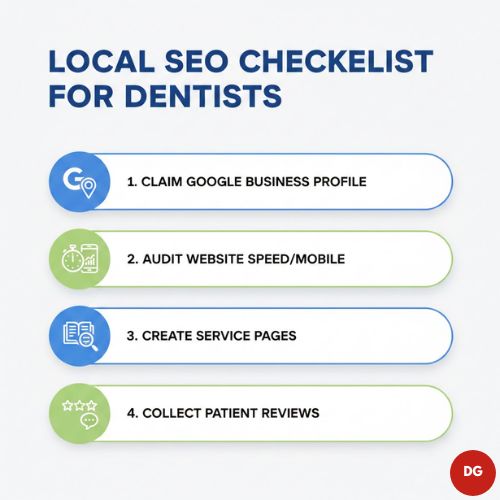
Week 1: Claim and Optimize Your Google Business Profile
- Verify your listing
- Fill out every section completely
- Add photos of your office and team
- Start asking satisfied patients for reviews
Week 2: Audit Your Website
- Test mobile responsiveness
- Check page speed
- Make sure you have HTTPS
- Fix any broken links
Week 3: Create Service Pages
- Build dedicated pages for each service
- Include local keywords naturally
- Add clear calls-to-action
Week 4: Start Creating Content
- Write your first blog post answering a common patient question
- Set up Google Analytics and Search Console
- Plan your content calendar for the next 3 months
Ongoing: Monitor and Adjust
SEO is a marathon, not a sprint. Keep creating helpful content, encourage reviews, monitor your analytics, and adjust your strategy based on what is working.
Most practices start seeing meaningful results within 3-6 months. Be patient and stay consistent.
Final Thoughts: SEO Is an Investment in Your Practice’s Future
The dental market is competitive, but
SEO for dentists gives you a fighting chance to stand out without breaking the bank on advertising.
Whether you tackle it yourself or hire professional SEO services for dentists, the important thing is to start. Every month you wait is another month your competitors are capturing patients who should be sitting in your chair.
Focus on local SEO, create content that genuinely helps patients, make your website fast and mobile-friendly, and build trust through reviews and quality backlinks.
Do these things consistently, and you will see your practice grow, one search at a time.
Ready to take the next step? Start with your Google Business Profile today. It’s free, it’s powerful, and it’s the foundation of everything else.
Your future patients are searching right now. Make sure they can find you.