Executive Summary & Key Takeaways
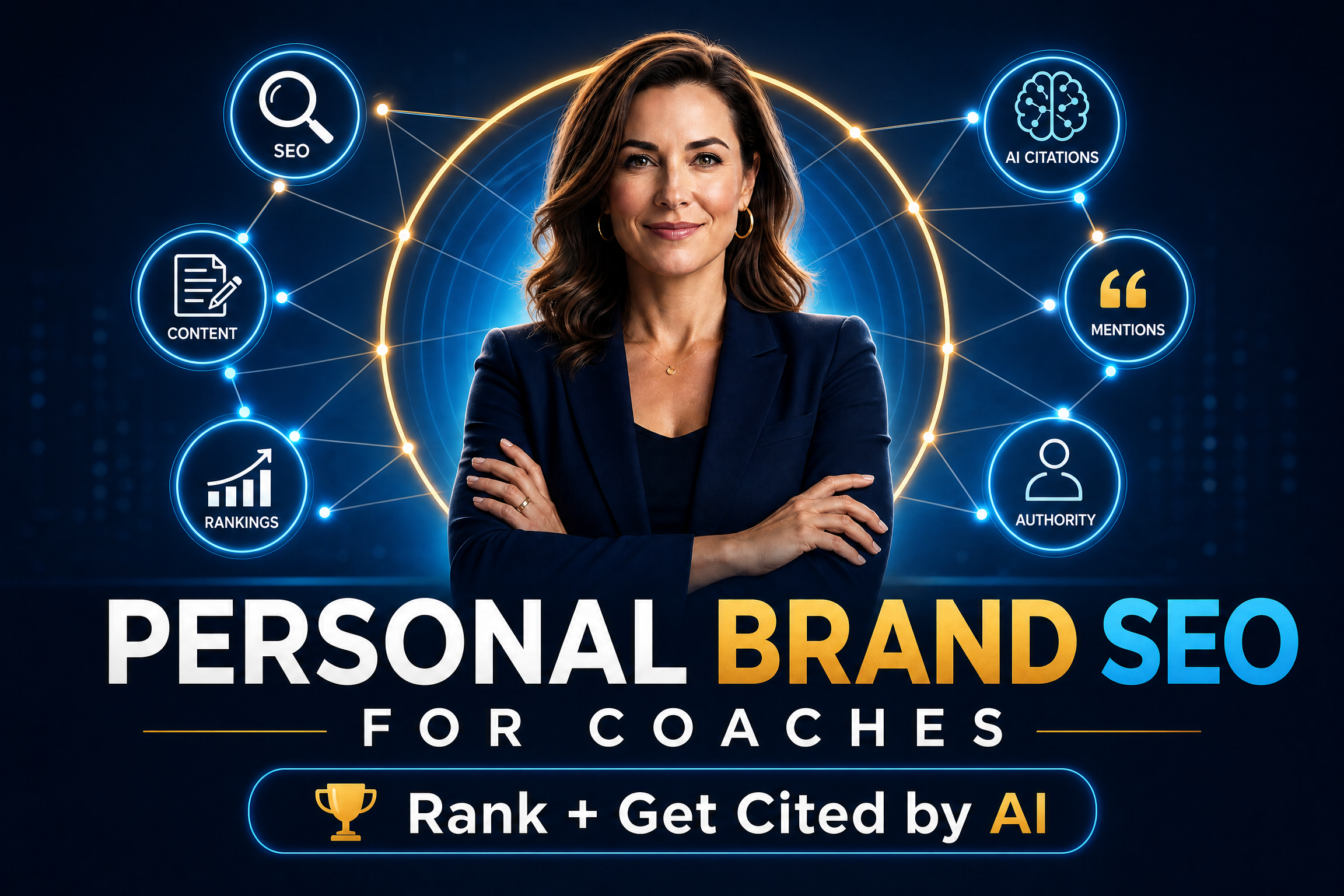
How business, life, and fitness coaches use personal brand SEO to rank on Google and get cited by AI answer engines.
Key Focus: Targeted search architecture optimized for high-intent conversions and AI engine discoverability.
Action Item: Implement structured entity schemas, direct answer blocks, and authority signal tracking.
People Google you before they book you. Not your company, not your service — you. If nothing comes up, or worse, if what comes up doesn’t match the expert they were expecting, they move to the next name on the list.
That’s what personal brand SEO fixes. It’s the practice of optimizing search engines to associate your name with your specific expertise — so when someone searches “business coach for first-time founders” or “life coach for career changers,” you’re the name Google (and increasingly, AI tools) surfaces.
Personal brand SEO is the process of building search visibility around a person’s name and expertise, rather than around a company or service page. It matters because clients hire people, not businesses — and search engines need clear signals to know which person to recommend.
What Is Personal Brand SEO (And Why It’s Different from Regular SEO)
Regular SEO ranks pages. Personal brand SEO ranks people. Google calls this entity SEO — treating you as a distinct, searchable entity tied to a topic, the same way it treats a company or a place.
The difference matters because coaches and experts don’t sell a generic service. A business coach, a life coach, and a fitness expert all compete on trust and personal fit — not just price or proximity. Your SEO strategy has to prove you’re the right person, not just that coaching exists as a service.
I’ve seen this with clients: a beautifully designed service page ranks fine, but the coach behind it stays invisible. Fix the entity signals, and the person starts ranking — which is worth more, because people book people.
The Three Pillars of a Coach’s Personal Brand SEO
Every strong personal brand SEO strategy rests on three things:
- Expertise content — writing that proves you know your niche, not generic advice anyone could publish
- Trust signals — testimonials, credentials, and named client results
- Distributed authority — your name and positioning showing up consistently across your site, LinkedIn, guest content, and interviews
Miss any one of these and the whole thing weakens. A coach with great testimonials but no content looks credible but invisible. A coach with content but no trust signals looks visible but unproven.
Content That Ranks Your Name — Not Just Your Services
This is where most coaches go wrong. They publish service pages (“Business Coaching,” “Life Coaching”) and stop. Service pages target people who already know what they want. They don’t build the entity signals that get your name recognized as an authority.
What actually ranks a personal brand:
- Case studies — real outcomes, named where possible (“How I helped a Kolkata-based founder double bookings in 90 days”)
- Frameworks and methods — a named system clients can search for and associate with you specifically
- POV content — opinions, not summaries. “Here’s what I’ve seen fail” ranks better than “Here are 10 tips”
- FAQ-style answers — direct responses to the exact questions your ideal client is typing into Google
This same niche-content approach is what makes industry-specific pages perform — the same logic that works for medspa SEO applies to coaching: specificity beats generic advice every time.
The Technical Layer — Person Schema and Why Most Coaches Skip It
Content builds the case. Schema markup tells search engines to believe it. Person schema is structured data that explicitly labels your name, your job title, your credentials, and your affiliations on the page — so Google doesn’t have to guess who you are or what you do.
Most independent coaches skip this entirely, which is a gap you can close fast. It’s a small technical addition with outsized impact on how confidently search engines attribute expertise to your name. This is the kind of structured groundwork that also feeds directly into answer engine optimization — the more clearly a page is marked up, the easier it is for AI systems to extract and cite.
Personal Brand SEO + AEO/GEO — Getting Cited by ChatGPT and AI Overviews
Here’s the part almost no one in the coaching space is doing yet: optimizing to be cited, not just ranked.
When someone asks ChatGPT or Google’s AI Overviews “who’s a good business coach for early-stage founders,” the answer comes from content that’s structured to be quoted — clear definitions, direct answers, credible sourcing. This is generative engine optimization applied to a person instead of a company.
To get cited by AI as an expert, your content needs clean, direct-answer paragraphs, clear authorship, and consistent expertise signals across the web — not clever copywriting, but structured clarity. In my work with clients, this is the single most underused lever in the coaching and expert space right now. Competitors chasing rankings alone are missing where search is actually heading.
Get a Quote → if you want your name showing up in both search results and AI answers.
Local vs. Global — Positioning Your Brand for Both
Coaches often serve clients both in their city and worldwide over Zoom. Your SEO needs to do both jobs at once: local signals (city name, Google Business Profile, local testimonials) for in-person searches, and topic-based, niche-driven content for global reach.
I run this exact dual strategy from Kolkata — targeting local clients while building content that pulls in coaching and consulting inquiries internationally. The same architecture works for any solo expert regardless of niche.
FAQ
What is personal brand SEO?
Personal brand SEO is the practice of optimizing search visibility around an individual’s name and expertise rather than a business or service. It uses entity signals — content, schema, and consistent positioning — to help search engines associate a person with a specific topic.
How is personal brand SEO different from regular SEO?
Regular SEO ranks pages and services. Personal brand SEO ranks the person behind them, which matters most for coaches, consultants, and experts whose clients are hiring an individual, not just a service.
How do I get cited by ChatGPT or AI Overviews as an expert?
Structure your content with clear, direct-answer paragraphs, consistent authorship signals, and schema markup that identifies you by name and expertise. AI tools pull from content that’s easy to extract and attribute — clarity matters more than clever phrasing.
Do I need a blog for personal brand SEO to work?
It’s not required, but it’s the fastest way to build the expertise content and trust signals that entity SEO depends on. Without regular content, there’s little for search engines to associate with your name.
Can a fitness coach or life coach use the same strategy as a business coach?
Yes. The three pillars — expertise content, trust signals, and distributed authority — apply across niches. Only the keywords and content angles change based on audience.
Conclusion
Personal brand SEO isn’t optional anymore for coaches and independent experts — it’s the difference between being the name someone finds and the name someone else finds instead. Build the content, add the technical layer, and structure for AI citation, and your name starts compounding as a search asset instead of staying invisible behind a service page.
I’ve built this exact system for 150+ clients with a 98% satisfaction rate, blending SEO, AEO, and GEO into one strategy most consultants still treat as separate. If you’re a coach or expert ready to make your name searchable — Get a Quote →.
Read more in our Industry-Specific SEO Guide.