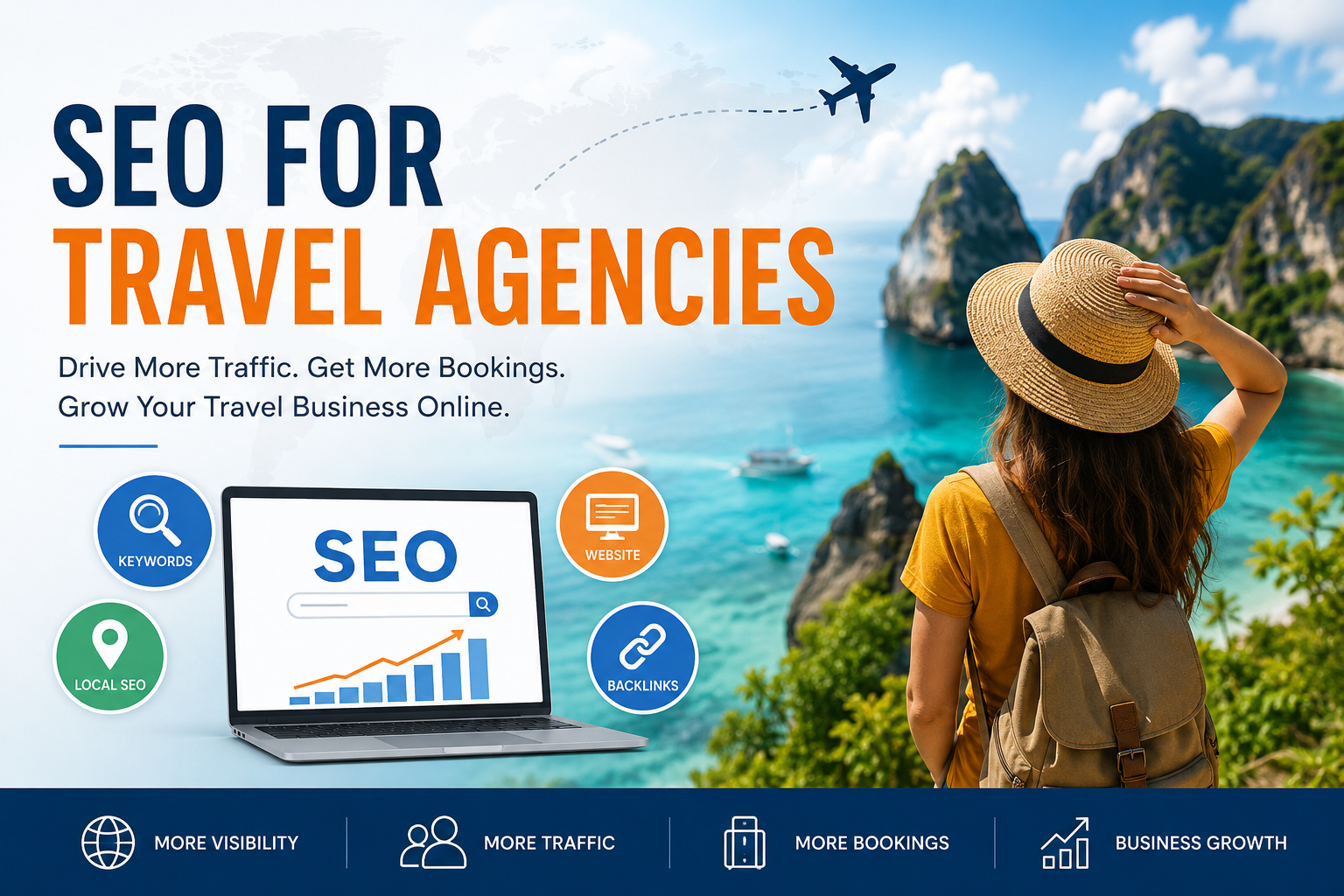

Executive Summary & Key Takeaways
Tired of losing bookings to OTAs? Here's a proven SEO strategy for travel agencies that drives direct enquiries — long-tail keywords, local SEO, AEO & GEO included.
Key Focus: Targeted search architecture optimized for high-intent conversions and AI engine discoverability.
Action Item: Implement structured entity schemas, direct answer blocks, and authority signal tracking.
90% of travellers start planning their next trip with a Google search. Yet most independent travel agencies never show up for those searches — buried under MakeMyTrip, TripAdvisor, and Booking.com, platforms with multimillion-dollar SEO budgets and decades of domain authority.
Here’s the reality: you can’t out-spend an OTA. But you can out-rank them on the searches that actually convert — the specific, intent-driven queries where your local expertise beats their algorithm.
This guide breaks down a practical SEO strategy for travel agencies and tour operators that drives direct enquiries, reduces OTA dependency, and positions your brand as the go-to expert in your niche.
SEO for travel agencies is the practice of optimising a travel agency’s website, content, and online presence to rank higher in search results when potential travellers research destinations, packages, and tours. Done right, it replaces paid commissions with a compounding organic channel — one that keeps delivering bookings long after you’ve stopped actively promoting.
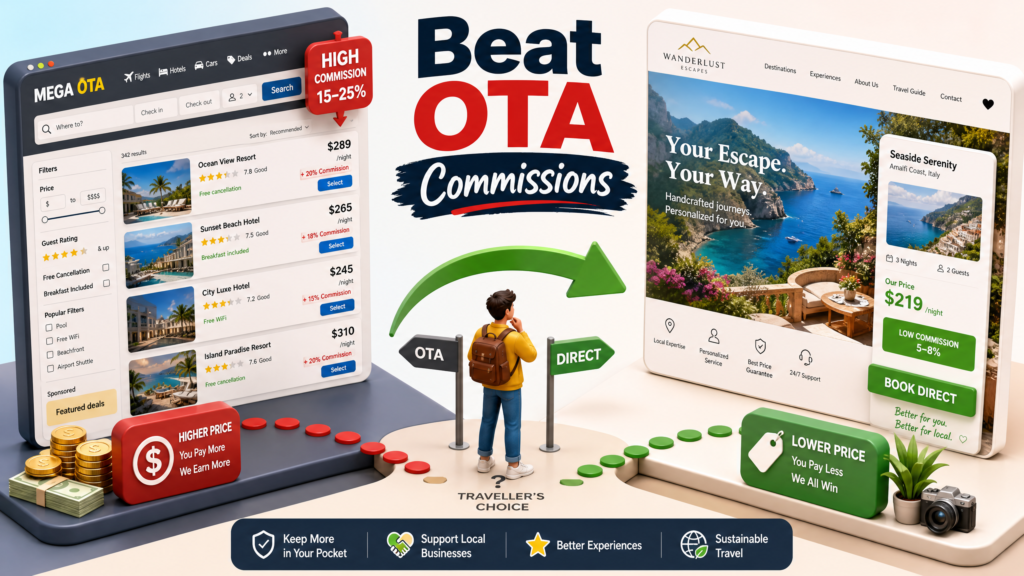
Why Travel Agencies Struggle to Rank (And What OTAs Know That You Don’t)
The OTA advantage isn’t mysterious. Booking Holdings and Expedia together control roughly 42% of the global online travel market. Their domain authority, link equity, and content volume are simply out of reach for an independent operator.
But here’s what most agency owners miss: OTAs are built for volume, not depth. They can’t write with genuine expertise about the 6-day Sikkim circuit you’ve been running for 12 years. They can’t describe the exact ghat where your Varanasi sunrise tour begins. They can’t answer the specific questions your niche travellers are typing into Google.
That’s your opening.
And it’s getting bigger. Google AI Overviews — the AI-generated summaries that appear above traditional results – saw a 381% increase for travel queries during the March 2025 core update alone. Travellers are increasingly getting answers from AI without clicking a single result. The agencies whose content gets cited in those summaries win visibility that no OTA commission can buy.
The 5-Part SEO Strategy for Travel Agencies in 2025–26
1. Target Long-Tail and Destination-Specific Keywords
Generic keywords like “tour packages India” or “best travel agency” are OTA territory. You won’t win there, and you don’t need to.
What you can win: the specific, conversion-ready queries that OTAs don’t have pages for.
Examples:
- “7-day Rajasthan trip from Kolkata under 30000”
- “offbeat Meghalaya tours monsoon season”
- “Darjeeling holiday package with transport and hotels”
These long-tail keywords have lower competition, higher purchase intent, and attract travellers who already know what they want. Target one primary keyword per destination or package page, then layer in seasonal variants: “winter Spiti Valley tour”, “Diwali Goa package”, “Durga Puja getaway West Bengal.”
Use Google Search Console to find what queries your site already shows up for — then build dedicated pages for the ones you’re ranking on page 2 or 3.
Looking for expert keyword strategy? See how I approach SEO for local businesses →
2. Build Destination and Package Pages That Actually Convert
Most travel agency websites have one generic “Tour Packages” page listing 20 packages in a grid. That’s not an SEO asset — it’s a conversion dead-end.
Build a dedicated page for each major destination or package. Each page should include:
- Primary keyword in the H1 and first 100 words
- Specific itinerary detail — day-by-day breakdown, not a vague overview
- Real pricing ranges — “starting from ₹18,500 per person” beats “contact us for pricing”
- What’s included / excluded — this directly answers the questions travellers are Googling
- FAQs specific to that destination — visa requirements, best season, packing tips
- A clear booking CTA — enquiry form or WhatsApp link, not buried at the bottom
OTAs skip the depth. Your page that genuinely answers every question a traveller has will out-rank their generic listing — especially as AI engines look for authoritative, detailed content to cite.
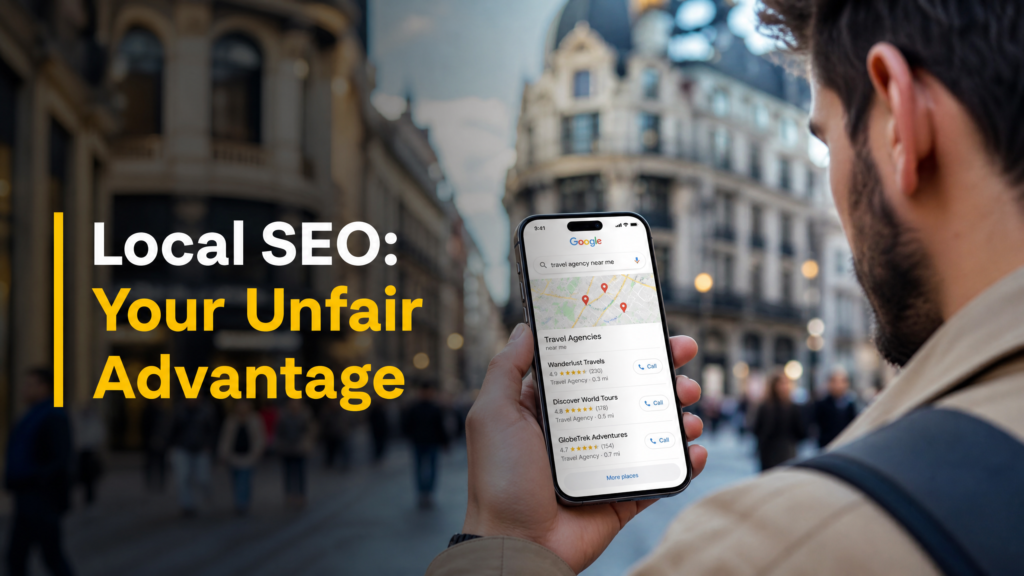
3. Local SEO — Your Unfair Advantage Over National Platforms
MakeMyTrip doesn’t have a physical office in your city that travellers can walk into or call. You do. That’s a local SEO advantage that national OTAs simply cannot replicate.
Google Business Profile is the foundation. Optimise your listing with:
- Accurate business category (“Travel Agency” or “Tour Operator”)
- Services listed with keyword-rich descriptions
- Photos of your team, office, and past tour groups
- Consistent NAP (Name, Address, Phone) across every directory
Directory consistency matters. Ensure your business details are identical across TripAdvisor, Justdial, Sulekha, IndiaMART, and Google. Inconsistencies hurt your local pack rankings.
Reviews are your ranking signal and your sales page. 76% of travellers check reviews before booking. Actively ask satisfied clients to leave Google and TripAdvisor reviews — and respond to every one. Review quantity, freshness, and owner responses all factor into your local search ranking.
4. Answer Engine Optimization (AEO) for Travel Queries
This is where most travel agencies are completely invisible — and where the biggest opportunity lies right now.
AI Overviews now appear for over 13% of all search queries, and travel is one of the most affected categories. When someone asks Google “what’s the best time to visit Spiti Valley?” or “how many days for a Kerala backwater trip?”, an AI-generated answer appears at the top of the page — pulling content from websites Google considers authoritative.
To get your content cited in those summaries:
- Write direct-answer paragraphs of 40–60 words immediately after each section heading — framed as a concise, factual response
- Add FAQ schema markup to every destination and package page
- Use TouristTrip and TouristAttraction schema to help Google understand your content
- Structure your FAQs around real People Also Ask queries — use AnswerThePublic or Google’s PAA box for research
A boutique agency with genuine destination expertise can absolutely get cited in AI Overviews over a major OTA — because the AI is looking for depth and authority, not domain size.
Learn more about Answer Engine Optimization and how it works →
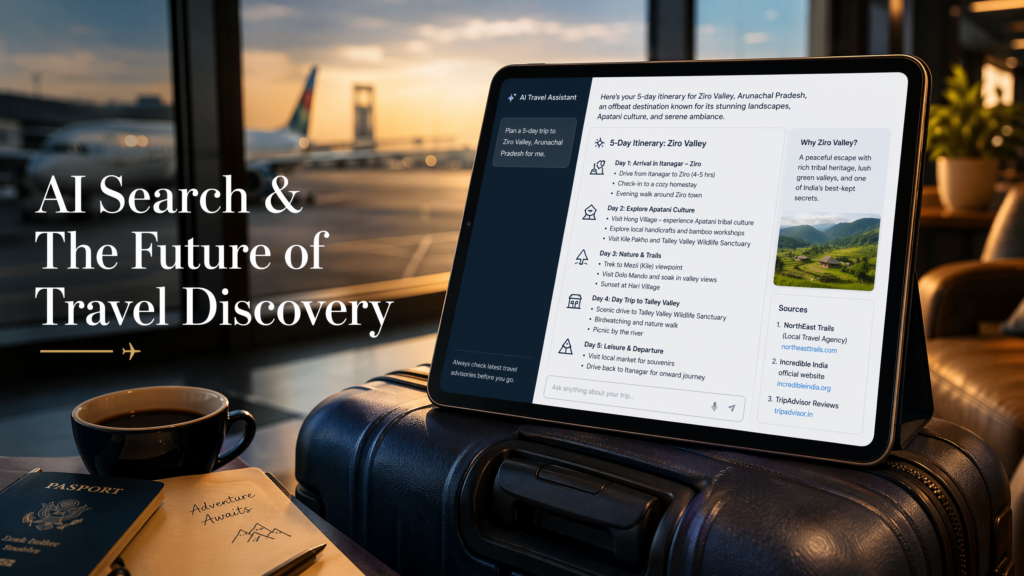
5. GEO — Getting Your Agency Cited by ChatGPT and Perplexity
Generative Engine Optimization (GEO) takes AEO a step further. Instead of optimising for Google’s AI Overviews, you’re optimising for the AI tools travellers use to plan their trips directly: ChatGPT (883 million monthly users), Perplexity, and Google Gemini.
When someone asks ChatGPT “recommend a boutique travel agency for a Northeast India trip,” the AI pulls from content it’s indexed across the web. Agencies that publish expert-led, well-structured, authoritative content — with clear author attribution, real case examples, and consistent brand mentions — are the ones that get recommended.
GEO signals for travel agencies:
- First-hand expertise — publish destination guides written from personal experience, not reworded Wikipedia
- Brand mentions — get featured in travel blogs, regional newspapers, tourism boards
- Structured content — use clear headings, FAQ blocks, and schema so AI can parse and cite your pages
- E-E-A-T signals — author bio, years of operation, client testimonials, certifications
See how Generative Engine Optimization can get your brand recommended by AI →
Ready to get your travel agency ranking where your clients are searching?
Get a Free SEO Audit →
Seasonal SEO for Indian Travel Agencies
Travel is inherently seasonal — and your SEO strategy should reflect that. The mistake most agencies make is publishing content during peak season. By then, you’ve already lost the ranking race.
Publish 8–12 weeks ahead of when your target travellers start searching. Here’s a rough content calendar to work from:
| Season / Event | Publish Content By |
|---|---|
| Diwali getaways (Oct–Nov) | August |
| Winter Himalaya / Spiti (Nov–Feb) | September |
| Christmas & New Year packages | October |
| Durga Puja specials (Bengal) | August |
| Summer hill stations (Apr–Jun) | February |
| Monsoon treks (Jul–Sep) | May |
Build destination-specific cluster content for each season — one pillar page per major destination, supported by shorter posts targeting “best time to visit,” “what to pack,” and “hidden gems near [destination].” This is the pillar-cluster model applied to travel, and it’s how you build topical authority that compounds over time.
Read the full Industry-Specific SEO guide to see how this fits the bigger picture →
Schema Markup for Travel Websites
Technical SEO matters, and schema markup is the one technical element that directly impacts both traditional rankings and AI visibility.
For travel agency websites, implement three schema types as a minimum:
- TouristTrip — for each tour or package page; includes destination, duration, price, itinerary
- TouristAttraction — for destination guide pages; signals to Google that your content is about a specific place
- FAQPage — for any page with a Q&A section; increases the chance of appearing in featured snippets and AI Overviews
Add these as JSON-LD in the <head> of each relevant page. If you’re on WordPress, plugins like Rank Math or Schema Pro handle this without code.
One more: Core Web Vitals. Most travellers search on mobile. A 0.1-second improvement in mobile load speed correlates with a 10% increase in conversions — and slow-loading travel sites lose bookings silently, before you ever know the visitor was there.
Frequently Asked Questions
What is SEO for travel agencies?
SEO for travel agencies is the process of optimising a travel agency’s website and content to rank higher in search engine results for travel-related queries. It includes keyword research, destination page optimisation, local SEO, link building, and technical improvements — all aimed at attracting travellers who are actively planning trips and driving direct bookings.
How long does SEO take to show results for a travel agency?
Most travel agency websites start seeing measurable improvements in rankings and organic traffic within 3–6 months of consistent SEO work. Competitive destination keywords may take longer. Local SEO — especially Google Business Profile optimisation — often shows results within 4–8 weeks.
Can a small travel agency compete with MakeMyTrip on Google?
Yes — on the right keywords. OTAs dominate broad, high-volume terms like “India tour packages.” Independent agencies win on specific, long-tail searches like “5-day Coorg trip from Bangalore with homestays.” These niche queries have higher purchase intent and lower competition, making them far more valuable for small operators.
What keywords should a travel agency target?
Start with destination-specific and package-specific long-tail keywords that match your exact offerings. Layer in seasonal keywords (Diwali getaway, monsoon trek, winter Himalaya), local SEO terms (travel agency in [your city]), and question-based queries (“best time to visit Meghalaya”, “is Ladakh safe in October”). Use Google Search Console and AnswerThePublic to find what’s already driving clicks to your site.
Does local SEO help tour operators get more bookings?
Absolutely. Local SEO helps travel agencies appear in Google’s Map Pack — the three business listings shown for location-based searches like “travel agency near me” or “tour operator in Kolkata.” These results show above organic listings and drive high-intent, ready-to-book traffic. For agencies with a physical presence, local SEO is often the fastest way to generate enquiries.
The Agencies That Win Direct Bookings in 2026 Start SEO Now
OTAs aren’t going anywhere. But the search landscape is shifting in ways that favour independent operators with genuine expertise, local knowledge, and structured content — if they act early.
The playbook is clear: long-tail destination keywords, dedicated package pages, local SEO hygiene, AEO-ready FAQ blocks, and GEO-structured content that AI engines can cite and recommend. None of this requires a massive budget. It requires consistency and the right strategy.
Across 150+ projects and 6+ years working with local businesses and brands, I’ve seen this approach transform digital presence for businesses that thought they couldn’t compete with the big players. The travel agencies that start building this foundation now will be the ones capturing organic traffic — and direct bookings — when their competitors are still paying OTA commissions.