
Executive Summary & Key Takeaways
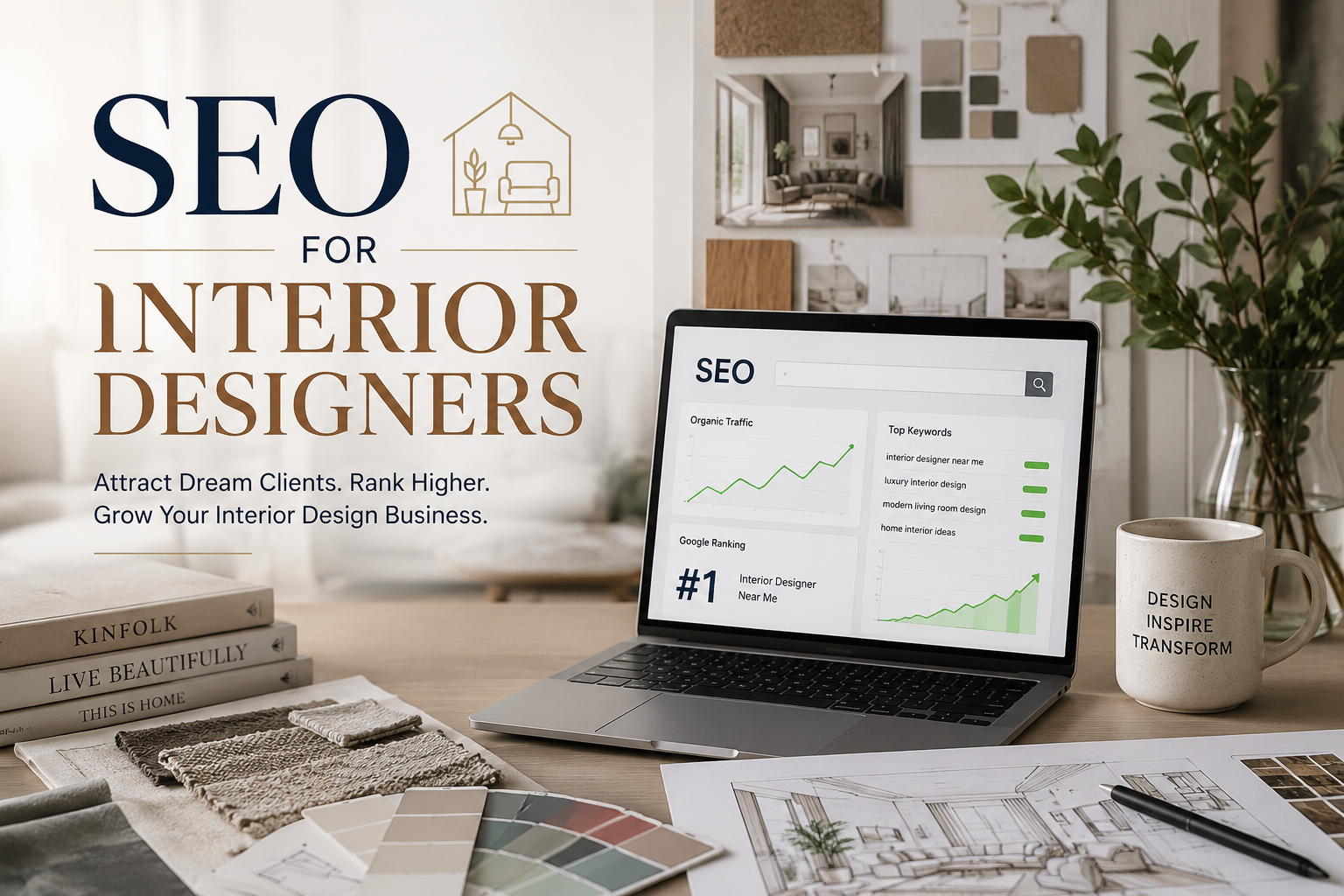
Most interior designers rely on referrals. SEO changes that. Learn how to rank on Google, attract high-value clients, and grow beyond word-of-mouth.
Key Focus: Targeted search architecture optimized for high-intent conversions and AI engine discoverability.
Action Item: Implement structured entity schemas, direct answer blocks, and authority signal tracking.
The global interior design market is on track to exceed $175 billion by 2030. Yet most interior designers are still waiting for the phone to ring — hoping a past client mentions their name to a friend.
Referrals are great. But they’re not scalable, and they’re not guaranteed. SEO for interior designers changes that equation entirely. It puts your business in front of people who are already searching for exactly what you offer — right when they’re ready to hire.
This guide breaks down how interior design SEO works, what makes it different from generic SEO advice, and what you need to do to start attracting clients from Google consistently.
See our full Industry-Specific SEO Guide
TL;DR — Key Takeaways
- Interior design SEO is different because your best work is visual, and search engines can’t see images without help.
- Local SEO and Google Business Profile are non-negotiable first steps.
- Portfolio pages need written content, not just photos.
- In 2026, AEO and GEO matter — AI search tools like ChatGPT and Perplexity are becoming a primary discovery channel.
- A well-executed SEO strategy replaces referral dependency with a steady flow of inbound leads.
Why SEO for Interior Designers Is Different
SEO for interior designers is the process of optimising your website, portfolio, and online presence so that potential clients find you through search engines like Google — rather than through referrals or paid ads alone.
That definition sounds simple. The execution isn’t — because interior design creates a specific challenge no other service industry faces quite the same way.
Your work lives in images. Your portfolio is your proof. But Google can’t look at a stunning living room transformation and understand what it’s seeing. It reads text, structure, and signals. If your website is image-heavy and copy-light, you’re invisible to search — no matter how talented you are.
There’s also a unique buyer journey at play. Most potential clients start on Instagram or Pinterest, get inspired, then search Google for an interior designer in their area. By the time they reach your website, they’ve already formed a visual opinion. Your SEO job is to show up at that search step — and then convert.
The 5 SEO Fundamentals Every Interior Designer Needs
1. Keyword Research That Matches Client Language
Most designers guess at keywords. That’s a problem.
Start with how your ideal client thinks, not how you talk about your own work. They’re not searching “residential interior design services.” They’re searching “interior designer near me,” “modern home interior designer in [city],” or “how to redesign my living room.”
Focus on three keyword types:
- Location-based: “interior designer in [city]” — these drive local, high-intent traffic
- Style or service-specific: “luxury bedroom interior design,” “Scandinavian home interiors”
- Long-tail queries: “how much does an interior designer cost” — lower volume, higher conversion
Build your service pages around location keywords. Use style and long-tail terms in your blog content.
2. Portfolio Page Architecture — Not Just a Gallery
This is where most designer websites lose the SEO battle before it starts.
A single portfolio page with 40 images and no text is a dead end for search engines. Instead, create individual project pages — one per major project — with a short written description (300–500 words) covering the brief, your approach, the materials used, and the outcome.
Name your URL slugs descriptively: /portfolio/modern-kolkata-apartment-redesign/ performs better than /portfolio/project-12/. Google rewards specificity.
3. Image SEO — The Untapped Advantage
Interior designers sit on a goldmine of visual content that almost nobody optimises correctly.
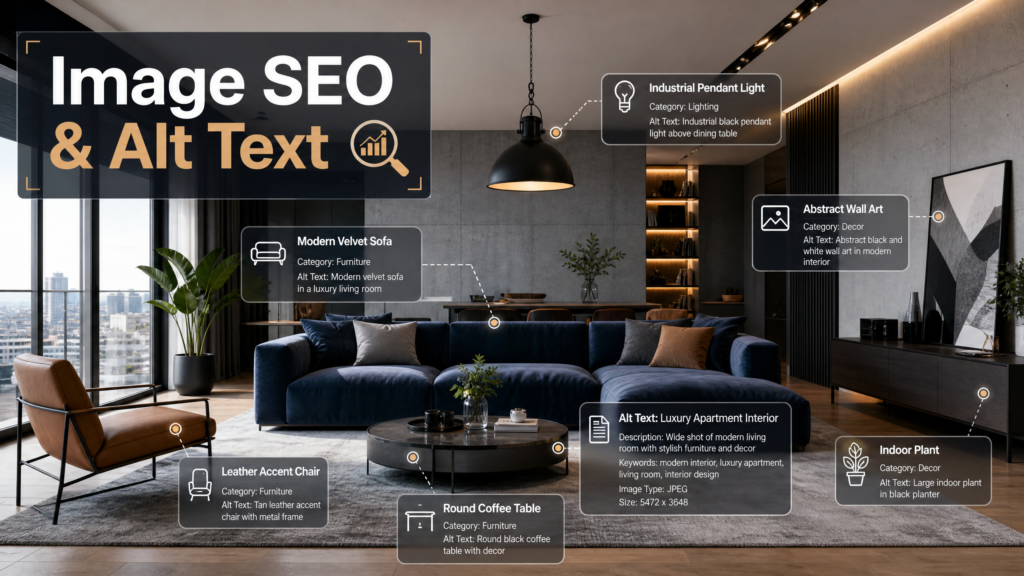
Before uploading any image, rename the file to something descriptive: contemporary-living-room-kolkata.jpg instead of IMG_4821.jpg. Then write meaningful alt text for every image — a one-sentence description of what’s in the photo, including location and style where relevant.
This does two things: it helps Google understand your content, and it makes your images eligible to appear in Google Image Search — a significant traffic source for design businesses that most competitors ignore.
4. Local SEO and Google Business Profile
If you serve clients in a specific city or region, local SEO is your highest-leverage starting point.
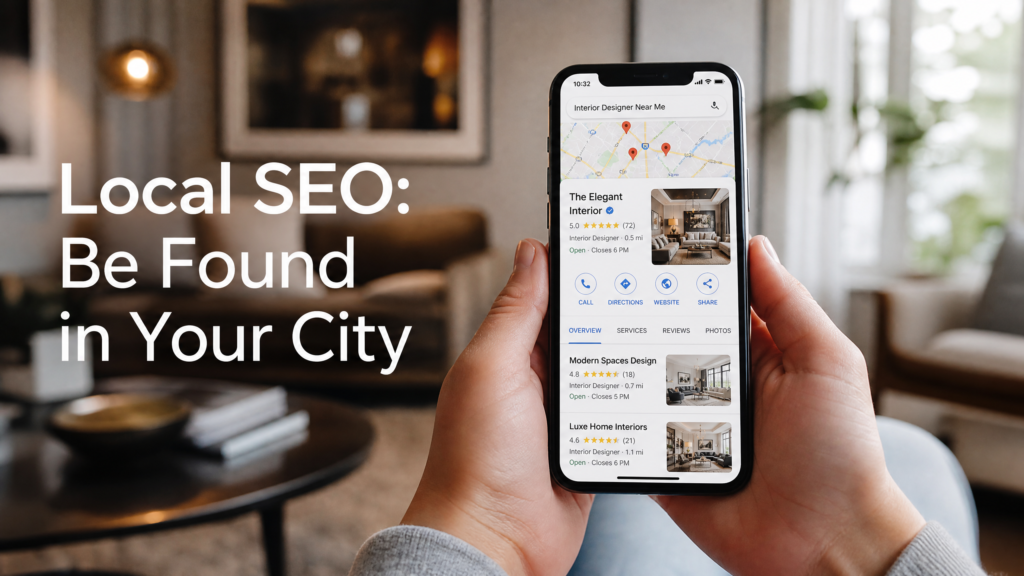
Claim and fully optimise your Google Business Profile. That means accurate business category (“Interior Designer”), a complete description with your target keywords, regular photo uploads of completed projects, and a consistent strategy for collecting Google reviews from past clients.
Reviews are not optional. Google uses them as a ranking signal for local searches. One genuine, detailed review from a happy client is worth more than a dozen social media posts.
Also ensure your business name, address, and phone number (NAP) are consistent across your website, GBP, and any directory listings like Houzz or Justdial.
5. Authority Content: Blogs, Case Studies, Project Stories
A static website doesn’t give Google a reason to keep coming back.
Publishing consistent content — project spotlights, style guides, “before and after” stories, design trend posts — signals to Google that your site is active and authoritative. More importantly, it gives you the opportunity to rank for the long-tail questions your ideal clients are already asking.
Good content topics for interior designers:
- “How to Choose the Right Interior Designer for Your Home”
- “5 Mistakes Homeowners Make Before a Renovation”
- “Modern vs. Contemporary Interior Design: What’s the Difference?”
Each one of these is a real search query. Each one is a door into your website.
The 2026 Edge — AEO and GEO for Interior Designers
Here’s what most SEO guides for interior designers don’t mention: Google is no longer the only search.
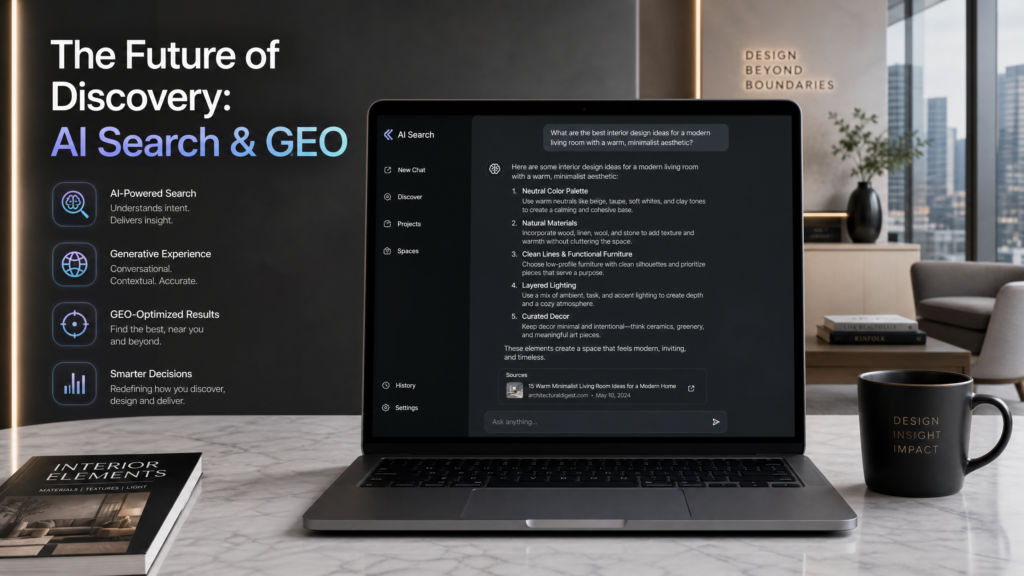
An increasing number of potential clients are starting their search on ChatGPT, Perplexity, Gemini, or using Google’s AI Overviews — and getting answers directly, without clicking through to websites. If your business isn’t appearing in those AI-generated answers, you’re missing a growing slice of discovery.
This is where Answer Engine Optimisation (AEO) and Generative Engine Optimisation (GEO) come in.
AEO means structuring your content so AI systems can extract and cite it as a direct answer. GEO means building your online authority and citation footprint so AI tools trust and surface your brand.
For interior designers, this looks like:
- Writing clear, direct answers to common questions (the FAQ format works well)
- Getting mentioned on third-party sites, directories, and design publications
- Structuring your service pages and blog posts with clean headings and concise definitions
I work with clients on both Answer Engine Optimisation and Generative Engine Optimisation as part of a complete SEO strategy — because ranking on Google alone isn’t enough anymore.
Ready to stop relying on referrals?
I build SEO strategies for service businesses that generate leads consistently — no ad spend required.
What Does Good Interior Design SEO Actually Look Like?
Let me give you a realistic picture of what happens when SEO is done right for an interior design business.
A designer with a portfolio-heavy website and no SEO presence is essentially invisible outside their immediate network. After a proper SEO engagement — keyword-optimised service pages, structured project pages, local SEO setup, and consistent content — they start appearing for searches like “interior designer in [their city]” and “luxury home renovation [city].” Enquiries begin coming in from people who found them through Google, not through a mutual contact.
The shift isn’t overnight. SEO typically takes 3–6 months to build meaningful momentum. But unlike paid ads, the results compound. A well-optimised page keeps working for you months and years after it’s published.
That’s the core value proposition: you build it once, and it keeps bringing clients in.
FAQ — SEO for Interior Designers
Does SEO work for interior designers?
Yes — SEO is highly effective for interior designers. Most potential clients search for design services online before making contact, and a well-optimised website puts your business directly in front of that intent. Local SEO in particular can drive consistent, high-quality enquiries from clients in your area.
How long does SEO take for an interior design business?
You can expect to see meaningful results within 3–6 months of consistent effort. Competitive local markets may take longer. The key is consistency — regular content, technical health, and ongoing optimisation compound over time and deliver returns that paid advertising cannot match long-term.
What keywords should interior designers target?
Start with location-based keywords like “interior designer in [your city],” then layer in style or service-specific terms such as “luxury bedroom design” or “home office interior designer.” Long-tail queries like “how to find an interior designer” are lower competition and attract clients who are actively researching.
Do I need a blog as an interior designer?
A blog is one of the most effective tools for interior design SEO. It gives you a way to rank for long-tail keywords, demonstrate expertise, and give Google fresh content to index regularly. Project case studies and style guides work particularly well and double as social content.
Should I hire an SEO consultant or do it myself?
You can handle basic SEO yourself — optimising your GBP, renaming images, and writing project descriptions are all DIY-friendly. But if you want faster results, a competitive edge in your market, or access to AEO and GEO strategies, working with a specialist is a better use of your time. Your hours are worth more designing spaces than debugging title tags.
Stop Waiting for Referrals
SEO gives interior designers something referrals never can: predictability.
When your website ranks for the right keywords, you’re not waiting for someone to mention your name at a dinner party. You’re showing up exactly when a potential client is searching — ready to hire, ready to invest.
The fundamentals aren’t complicated: keyword-smart service pages, properly structured portfolio pages, image SEO, a strong Google Business Profile, and consistent content. Layer in AEO and GEO, and you’re ahead of 90% of your competitors.
I’ve worked across 150+ projects with a 98% client satisfaction rate, helping service businesses build digital visibility that lasts. If you’re an interior designer ready to grow beyond referrals, let’s talk.